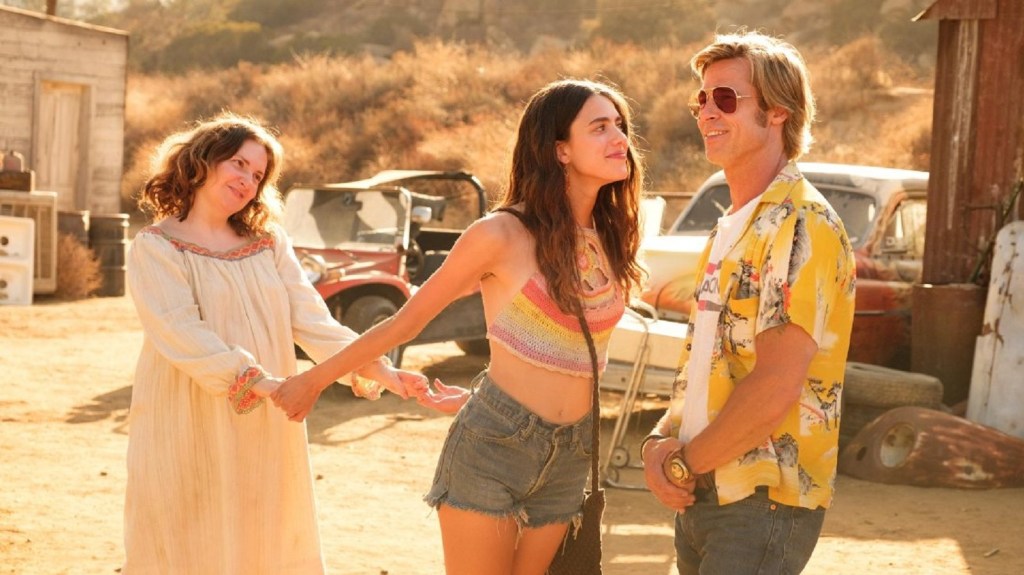
Once Upon A Time In Hollywood (2019) is a standard Disney fairy tale with slasher aesthetics, a cast that’s too good for it, and a director now perhaps permanently up his own mythos.
It gives us morsels of truth in order to cover up a fat lie, and the breadcrumbs that led me through the woods, while bypassing the witch’s lair, turned out to be a byproduct of a particular type of authentic enchantment. The one redeeming feature about the whole endevour – Brad Pitt‘s actual acting chops.
And on the face of it, Quentin Tarantino‘s new film, set to be a showreel glorifying the industry of canned dreams, in a backhanded kind of way, turned out to be all about the Pitt. The Hollywoodness of Brad. The finest Tinseltown can offer, without the obligatory self-serving squirm – the Missouri guy that looks like Apollo, talks like a farmer, is loyal to his dog, and always has your back. Also fit enough to knock out Bruce Lee (Mike Moh). With sheer sarcasm. A reluctant gent, and catnip for the ladies. Albeit a guy that killed his nagging wife and got away with it. In the story.
I bounced my way out of the cinema, knowing I was spoon-fed speed, but finding happy nourishment in the sugar, all my girlhood crushes revived and redeemed. Predictably, a nasty feel soon set in, somewhere in (the pit of) my gut. That instinct we all should follow while in the woods, off our faces, but we don’t.
In a way, Mr Pitt, as such, possibly unwittingly, might be the greatest cinematic illusion of them all. Lending his decency and skill to a scam. Or maybe he’s the scam. Dunno. When we buy into the unreal, it takes time to figure it all out, and ugly reality can sneak up on us. Like it did to the people in tragic number 10050 Cielo Drive.
For in life, there is rot. And this film has a special way of addressing its own rot, in a way that is an apt allegory for the delusional arc of Hollywood. Its internal downfall lies in the fact that this insight is most definitely accidental. It’s all supposed to be a showbiz joke that’s not a joke, which is a joke only showbiz insiders could really get. And we are let in, for a pervy peek.
It’s the crack in that eternal sunshine that let the light shine through.
This story is a two-hander, of a failing Hollywood B movie player, and TV actor, Rick Dalton, on his way to spaghetti western stardom (Leonardo DiCaprio doing his very best to disregard the cartoon ethos), and his loyal stunt man Cliff Booth (William Bradley Pitt, owning the cartoon ethos), while times are a-changing, and neighborhoods are too. Sharon Tate (Margot Robbie, iconic and sadly redundant) moves in with her husband Roman Polanski (Rafal Zawierucha) next-door to Rick and, at the same time, presents both a sunny opportunity and dark foreboding marking the death of Rick’s career.
They are the new cool, he is significantly out of touch. Robbie merely gets to play a feeling, an energy, an image, a human light-bulb, not a person, yet she’s strangely excellent at it, because at this point, she can do more or less anything.
Let’s tackle the backstory a bit, like we would if we were a forensic psychologist. Because what we have is a gruesome murder scene, on the one side, and a town that decides what the truth of it will be, on the other. It’s 1969, and Manson (Damon Herriman) is the hidden disease of Hollywood. The demon child who will slay the hippie daydream come summertime, leaving the soft pastel tones of endless parties and tequila sunsets bloodstained and bare. In RL, he was the town pimp and pusher, a refugee from a horrific childhood, a boozy disloyal teenage mom, and a history of institutional abuse that is astounding, with grandiose high-strung dreams of his own, and a raging mental illness that could not be contained within the caste system of the film and music industry.
Thus the monster was released out of its own inner bounds, infecting starstruck outcasts, mostly runaway teens, whose vulnerability was their own lack of life experience and a need to be accepted yet unique. The way all cults are born. What Charlie provided was his own brand of narrative hallucinogens.
His counterpart, in myth, would be the damaged hero that slays the Minotaur, ridding the city of its nemesis, while reluctantly questing on the path to righteousness.
And we get that, but without the complexity, subtlety, and wisdom of the myth (or, in fact, of actual cinematic masterpieces, like Pulp Fiction, or Jackie Brown). Because when a fully fleshed Cliff Booth aka Brad Pitt arrives at the Spahn ranch, a former movie set where the Manson family now roosts, all we get is cookie-cutter villains in a group setting and one good man standing – a scene straight out of a particularly boneheaded western/police procedural. Of which there are many clips dispersed, as they are Rick’s bread and butter.
Once Upon A Time in Hollywood does that pimp thing where it tries to sell you the very stuff it mocks. All that was missing was a whiff of red menace someplace, and I’d be pressed to think we were being canvassed to vote Reagan a decade too early.
This film, shallow as it is from the inside, and well crafted, as it is, from the outside, unintentionally exposes Hollywood dealing with its own internal rot the only way an industry built on manufactured reality can – with a minimum of self-awareness, maximum self-aggrandisement, twisting the narrative in a direction that is pleasing to the ego, entirely devoid of any essential truth.
The original narcissist.
★★☆☆☆
Author: ©Milana Vujkov
 Lola On Film
9 responses to “Once Upon A Time In Hollywood”
Thank you so much for being one of the few reviewers to actually get what was going on here, and on correctly diagnosing the central issues with all of Tarantino’s films – the directors pathological narcissism, to which I’d ad his obvious misogyny, both of which covers over by acting some sort fringe film historian, when he’s actually just some sort of infected tick on the corrupted ass of Hollywood.
The beginning of Tarantino’s career marked a flamboyant visual style and idiosyncratic dialogue that was incredibly original, genious, even. I would never be harsh with words in terms of a person, or diagnose them in any way, but in terms of his work, it later became a closed-circuit celebration of his own oeuvre.
A fantastic review, one I wish I would have read back when I’d recently seen the film. You articulated perfectly what I was feeling back then, but I could never quite find the words to describe exactly what the problem was. I do have to admit, being the film nerd that I am, at least part of me still just kind of loves the feeling of being part of the process when we are placed in the movies in films like this one. Plus, I happened to have visited the Warner Brothers lots at the time Once Upon a Time was being shot and actually saw a number of the shots being set up, so I was primed to want it to go down easy.
Despite all that, I left Once Upon a Time with the same slightly upset stomach feeling I usually get after most of Tarantino’s movies; like I just ate something that I shouldn’t have. I felt the same way after seeing The Player back in 1992; clever satire that feels more than a little sour after. Both films are exciting and snarky and colorful yet feel a bit empty to the soul. Almost all of Tarantino’s films, for me, come down more in the appreciate and respect category than in the love column. Maybe it’s the uneasy feeling that he seems to enjoy a certain kind of cruelty that I never can (nor do want to).
Thanks for giving a more cogent and analytic voice to my gut feeling.
Thank you, excellent points, as always. And wow for being there on set, that must have been an experience.
In truth, I was a real Tarantino fan until Inglorious Basterds. Since then, it’s bumpy. (Django was excellent).
Altman, I find, is an entirely different kind of cerebral filmmaker, he never played to audience expectations. I really clicked with The Player, because it does not glorify the shallowness and the fuckery it depicts, which is the point of satire (not to).
Also, I don’t mind queasy, at all. Sometimes it’s a good sign. Art should not be comfortable.
But I do mind when it’s disingenuous.
Art should not be comfortable. But I do mind when it’s disingenuous.
That’s really the heart of what I mean. I rarely shy from cinema that is challenging, if anything I may be a little too inclined towards it. But I won’t keep going back the table if I think the director is essentially misanthropic (Lars von Trier immediately comes to mind, as does Oliver Stone).
David Lynch may dive deep into the darkness, but I know at heart he is searching for beauty and resides in a place of kindness. I’m even not sure Tarantino is aware enough to actually be misanthropic, though I’m also not sure that’s a valid excuse either.
😉
Here we differ.
I don’t mix the personality of the artist with their art. In fact, I am incredibly opposed to that perspective, which is becoming widespread. I don’t care if the artist is kind or not, as long as they are dedicated and have integrity in what they do. If they don’t, and they stop becoming good at what they do, their character becomes the point.
If I thought otherwise, I might have to let go of the works of my favourite artists throughout history, and purge my shelves of everyone I find personally unpalatable in some way. In cinema, one of them is definitely von Trier, whom I revere as filmmaker, but who’s clearly a bit of a difficult bloke. (Stone is also a good filmmaker, on occasion, brilliant)
Art is so often a way we seek release, self-knowledge, and finally redemption from our own darkness, and the best art I find, sometimes comes from the most hardened of places. If it is great art, it redeems both the maker and its audience.
Trier’s misanthropy is well founded in his films, it’s not arbitrary, and it serves an artistic purpose.
I see you point and mostly agree, though I draw the line with spending money that supports artists that probably deserve jail time.
That said, my position that some filmmakers are basically misanthropic is not based on interviews, personality or biography though: it’s entirely based on my assessment of their art, i.e. their films. For all I know, Mr von Trier is a lovely and compassionate human being who’s nice to have as a next-door neighbor. But I’ve never seen a film of his that I didn’t leave thinking that his underlying perspective was one of loathing and contempt (both for his characters as well as the audience). Much the same has been my experience with Oliver Stone’s work. The lone exception in von Trier’s case being Melancholia, which had at least a few glimmers of compassion here and there, though it was still in the context of the entire planet being annihilated. It was also gorgeous and well-made as well, so there’s that.
I’d contrast von Trier’s work with a film like Requiem for a Dream, which as dark and stomach-churning as it was in the final act, felt like it came from a place of truly broken-hearted compassion. Aronofsky isn’t afraid to look into the dark, nor to show the ugly, but I always feel some level of hope and kinship with his characters, even the ones that are doomed.
I understand what you mean, but still disagree. The character of the artist is always connected with their work, because their art is the reflection of their inner world, so it sips through, it’s part of the package. In terms of jail time, that would be Dostoevsky, Caravaggio, Oscar Wilde, Jean Genet, Voltaire, that’s just off the top of my head.
p.s. I am absolutely OK with the fact that you dislike the work of these filmmakers. It’s just that you phrased it as connected to their personalities, not their work. My reaction had to do with that.
“if I think the director is essentially misanthropic” not that the work is, etc.