What we have here is that old paradox in assessing a work of art. Are elements of it the treasure, or is its entire form? In that sense, how to view a film which is otherwise disappointing, but has an outstanding central performance?
In cinema, this paradox regarding art has an added conundrum. Unless one is into auteur theory, it is hard to disregard the observable fact that, although a directors’ medium — film is very much a group effort. Perhaps, the most collaborative art of all.
This was my key dilemma before writing about Darren Aronofsky‘s The Whale (2022), adapted from a play by Samuel D. Hunter (who pens both) — a subpar film in an otherwise masterful output of the filmmaker, weak not in craft (which is almost impossible for the gifted Aronofsky), but in sustaining the integrity of the narrative.
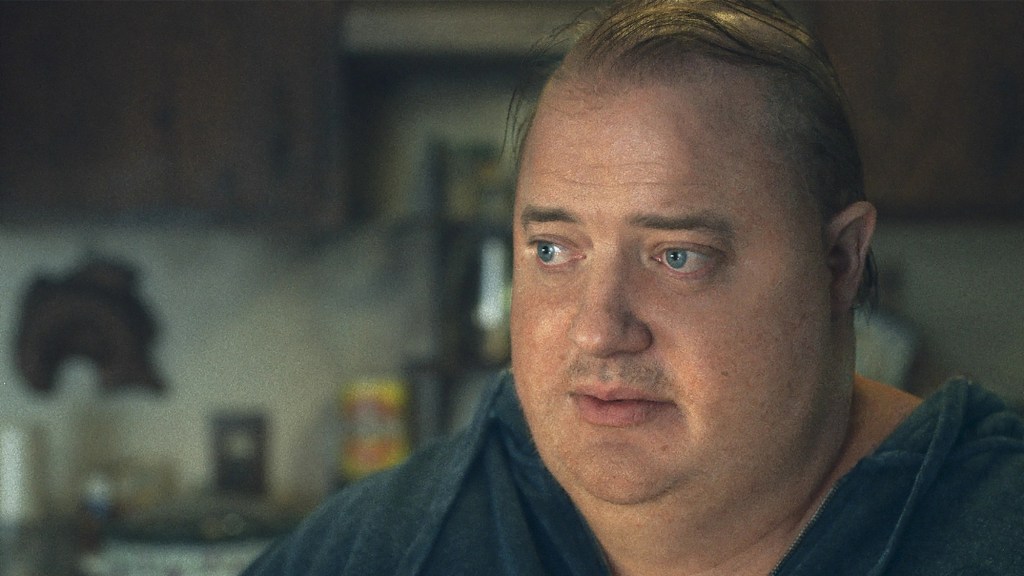
To be fair, there are holes in the script, itself. So all the weight of the story (metaphorically and literally) is carried by its tragic protagonist — the ailing Charlie, whom Brendan Fraser portrays with such depth, nuance, and wit. Nothing in the film’s text matches this commitment, and that’s a problem.
The claustrophobia and insularity of Charlie’s existence is depicted in detail, and well. His life in an airless prison of his own making — the pizza deliveries at his doorstep, the lack of camera visuals in the online English class he is teaching, that one reason why Charlie expanded himself to his current size of extreme morbid obesity. The ghost of his deceased lover Alan, hiding in plain sight, a palpable presence in every frame. The suicide of his partner, for whom he left his family, and who was a former student (strangely, but not unexpectedly suffering from anorexia, and religious guilt), has pushed the kind, thoughtful Charlie to absolute depths of despair.
The only friend he has checking in on him, is his ex-partner’s sister, a feisty no-nonsense nurse, Liz. A forceful yet somehow restricted performance by Hong Chau, who was not given enough milage to convey this character on its own merit. The moment we get to learn a bit more about Liz, the camera turns back towards Charlie. Everything around Charlie seems to fragment itself to uphold his predicament.
That is, until his daughter Ellie (Sadie Sink) marches in, and commands our full attention just by aggressive movement alone. Unfortunately, there is no substance in the text to account for this change of tone. Ellie’s redemptive arc from teen sociopath to a caring soul is fast-tracked.
A similar thing could be said for all the other people moving around in Charlie’s confined space — the young missionary (Ty Simpkins) trying to convert him, Charlie’s ex-wife (Samantha Morton) trying to (belatedly) understand him, the lurking pizza delivery man Dan (Sathya Sridharan) curious to meet him, the writing group he teaches, trying to please their astute lecturer — they are all more or less rushed actions or feelings rather than rounded characters, natural forces that our protagonist has to encounter and react to on his road to oblivion. By slow suicide. The key individual of which is, of course, his beloved troubled daughter, whose kindness he believes in, despite all signs to the contrary.
The method chosen by Charlie to annihilate his pain is to force-feed himself to death, while denying himself healthcare. And thus atone for his guilt of abandoning Ellie by leaving the money he saved to her, instead.
Depicting others as mirrors to Charlie could have been a solid directorial decision taken in order to convey his state of deep loneliness and unconsolable mourning — were it not for the thematic drops in dialogue, and a shift in focus onto something else. Namely, Charlie’s body.
So we come to the most likely culprit that damaged The Whale, in a directorial sense, with its apt Moby Dick reference of a hunted and misunderstood creature, one with a heart and soul encapsulating the sorrow of the world — and that is the needlessly prolonged and intense gaze upon Charlie’s physicality. Although the rationale for showing the consequences of Charlie’s violent binges is quite understandable, as well as is delving into the act of eating itself, Charlie’s go-to solace and his mortal enemy. Allowing us to feel the confines of his physical being.
However, this approach was a two-edged sword, especially for a film that at it centre examines the hurtful prejudices society has regarding the state of being overweight, the way an individual values his own life in those terms, and the cruelty of the fact that our appearance so often overshadows other elements of our humanity, which more likely define us.
For the bodily aspect of Charlie to become such a significant part of the story itself, in the end, killed the point The Whale was aiming to convey.
★★★☆☆
Author: ©Milana Vujkov
 Lola On Film
12 responses to “The Whale”
Wow,what a tough review. How would this writer, Miliana Vujkov, have done it better?
The film kept my attention on the poor human whale and his stifling surroundings. I thought the nurse actor was excellent at balancing the hardass with the kindly caregiver.
Brendan Fraser’s acting was nuanced and utterly compelling. He conveyed most everything with his face. Not an easy task. So bravo, bravo for these two actors!
Sadie Sink playing the alienated teenager was pretty awful. All she did was break shrill and inflict her mental cruelty on the poor Charlie. Both her linguistics and body language were so stiff it felt like she was a first year drama student who thinks yelling and stomping make for great acting. I was a very rebellious and angry teenager, but I also had my obedient and pleasant side. Yes, I know she had to follow the script, but that is the framework any actor must deal with. Was she a daughter of one of the producers?
This film earns a ten because of Fraser and Vojkov and the othe director Darren Aronofsky. Ialso want to mention the actor Ty Simpkins, who played the LDS missionary. I know that he is not labeled that way, but I know enough family who are Latter Day Saints and Simpkins absolutely portrays them.
The word “other” should not be there. The editing program made it such that I could hardly sthrnee what I’d already written. It could be ’cause of my tiny screen phone or it could be the primitive program on which to write reviews.
I already made my comments.
Great. A review of a review.
Very well rounded and sober review and one I agree with on all points! One part that I felt could be portayed a. bit stroner is the political aspect, not only of the societal and medical burden on people with eating disorders but the US system of lack of public healthcare which in the end is in the heart of the story too in my view. Adding to it, I was also not keen on manipulative rather than emotional music soundtrack. Overall I enjoyed it but I agree with each and every point of the article. Thank you.
Agree with the healthcare aspect, absolutely. It’s something I should have mentioned in the review as being only briefly touched upon in The Whale, and pushed aside for the relational sentiment. Thank you for your thoughtful comment and kind words.
I think that’s because the financial aspect probably wouldn’t have changed the outcome.
Charlie isn’t avoiding medical care because he can’t afford it – as many people in his position would incur debt rather than die.
Charlie is avoiding medical care – and would even if it were free – because his life after Alan’s death has been miserable, suffering, and depression. Charlie is self-loathing. He hates what he has become. He hates how empty he feels without Alan. He hates the pain he inflicted upon Mary and Ellie. And he hates the burden he places on Liz. He completely avoids the world, not just because he is embarrassed, but because he has withdrawn from it.
In a sense he has already committed suicide and separated himself from the living, and the only reason he continues to wake and breathe is to gain more money to hopefully atone for the pain inflicted on Ellie.
How is the Melville quotes from the book relevant to the film? It seems like it was critical to understand its meaning.
“Ellie’s redemptive arc from teen sociopath to a caring soul is fast-tracked”
I feel like you didn’t understand the arc/point here.
Ellie isn’t “redeemed” and she’s also not a “teen sociopath.” She is the abandoned daughter of a parent forced to leave, a situation that is not completely foreign to children born from 1985-2000, with parents who matured in an antigay society, married and birthed children, and then were able to move into their true selves.
Ellie is an unfortunate byproduct of societal hate.
This hate is internalised by her and projected onto others, especially the parent who “abandoned” her.
She isn’t redeemed at all. Rather, Charlie is the loving father he always wanted to be and that Ellie never had. He sees all of the good in her, in this life he helped to create, because she is his daughter and because regardless of what she has said or done, he loves her.
The entire time Ellie is (poorly) coping with the abandonment and lack of love from her father, and finally in the closing moments, she has the confirmation that he loved her all along. Only truly learning this as she reads her essay aloud to him in his last moments, knowing that this essay meant so much to him, as she obviously did too.
After watching the film, I was baffled at seeing a 3.7/5 on letterboxd. When I went on rottentomatoes, I saw more scores in the ballpark from critics that made sense rather than audiences. After looking through the critic reviews, I found your one: I couldn’t have agreed more to anyone’s review than this one. You definitely hit the nail on the head when it came to how I felt throughout the film: Brandon’s acting is impeccable but the supporting cast is lacking and as you mentioned is correctly placed on the burden of the narrative.
I didn’t know the movie was based off a play because it literally felt like a play. Characters would wait around for the next line to pop-up in their head or wait on queue when they were needed on the set, it was such an odd sight that hampered the film. And the drama felt lukewarm, whenever we got to a point of dramatical build up or epiphany it was dissipated quickly to move to the next thing. The bubbling of the drama at times felt like a farce since as easily as it erupted it was quickly ruptured rather than slowly and gracefully simmered like how most great dramas have done it.
And it’s good to know that I’m not the only one that felt character actions and plot points were rushed in the film.
Thank you.🙏 Even if we had disagreed, excellent analysis.
My 0.02: Frazier’s spellbinding performance alone makes the movie worth watching. The self-harm scenes were tough to take, but ultimately contributed towards the film’s conclusion. For me the weakest part of the movie wasn’t any of this, but rather the handling of the literary subject matter – I mean, there is supposed to be some sort of metaphor going on with Melville’s classic novel but it doesn’t really work. Is Charlie supposed to be Moby Dick the whale, Or Ahab, or Ismael or what? There are reasons to suspect each of them (remember Ellie describes Ismael as starting the story “in bed with a man”…subtle!) but they are all really shallow parallels. And Ellie’s essay, to be blunt, sounds like it was written by someone who vaguely knew the story but never read the book. Which I honestly think is the actual case with Aronofsky, which really rubs me the wrong way