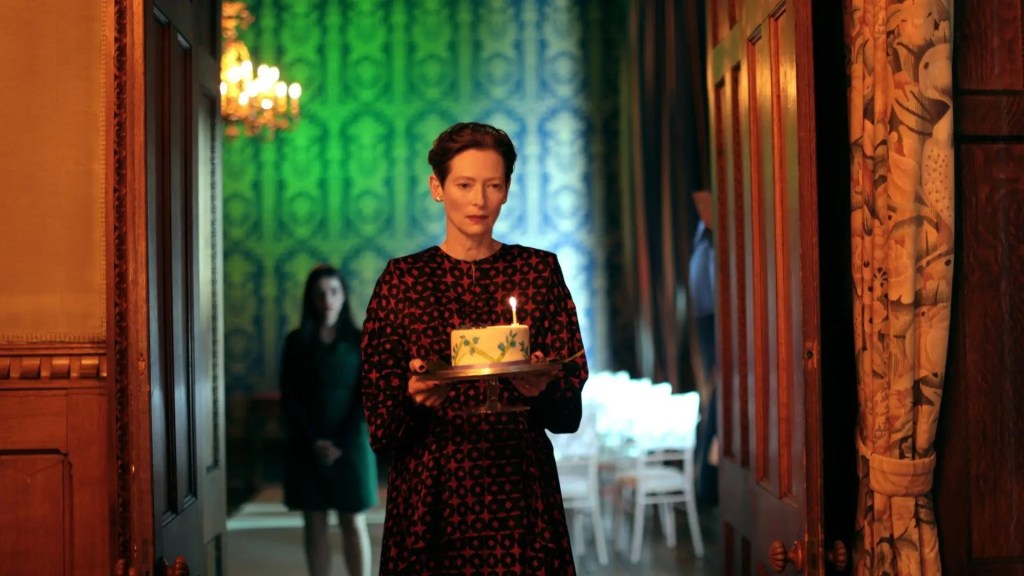
Exasperating, until it becomes heartbreaking, Joanna Hogg‘s cryptic The Eternal Daughter (2022), executive-produced and mentored by Martin Scorsese, is a Gothic tale with a twist that one can sense coming from the first minutes the film rolls. It’s the road that it takes to its inevitable conclusion that is the mystery — at times, reaching such a dramatic standstill, that the claustrophobic settings of its protagonists, patrician elderly mother Rosalind Hart, and jittery middle-aged filmmaker daughter Julie Hart, both played by Tilda Swinton, translate to whomever is watching, through pure disorientation.
At least it did, in my case. Prompting an urge to heckle at the screen.
Nevertheless, I kept going, a sure indication that the story has indeed something to say, but is, in my mind, struggling in arriving at its destination. Only after it takes us through a wasteland of atmospheric, somnambulic, fragmented soul-searching does a breakthrough (an eruption, of sorts), emerge.
Decked out in 1970s horror aesthetics of Argento’s Suspiria (1977) or Roeg’s Don’t Look Now (1973), wonderfully and eerily shot in 16mm by Ed Rutherford, The Eternal Daughter initially promises something equally wicked and arcane, or at least entirely otherworldly — hidden deep in the monumental, creaky mansion hotel in Wales, surrounded by mist, where the story takes place. A site apparently related to the Hart’s family history, brimming with memory. Here Julie plans to celebrate Rosalind’s birthday, running a full circle into her mother’s WW2 youth.
And right off, as is expected, their taxi driver warns Julie of a possible haunting at the site. If this would take the rich, traditional ghost story route — dark mood and chills would give way to what at first might be hallucinations, and then turn into a gruesome reality.
However, although the film hints at the possibilities, none of this is key in Hogg’s profoundly psychological self-examination, an internal gaze at familial dynamics, centring on the foundational, seldom entirely smooth mother-daughter relationship. One in which one party knows much about the other, but not, in fact, vice-versa. The scenic set-up of the film is a ruse, a MacGuffin, as the true secrets of the dissociative, distorted reality could very well exist solely in Julie, herself, the (proverbial) childless female artist, who, in the (overheard) words of her mother, exchanged family-making for her art.
Swinton plays the matriarch in a theatrical kind of way, which is clever, and necessary to establish the disjointed reality the characters inhabit. Nevertheless, Rosalind appears as a calmer, wiser, more authentic version of her apprehensive daughter — which is no surprise, as Julie becomes an increasingly eager-to-please extension of her mother. Mirroring Rosalind in order to establish the yearned for connection, and an understanding of her beloved (and distant) mother’s interior life. A doppelgänger-y fully achieved by Swinton’s dual roles.
The older woman is all lavender, tea, tiny pillboxes, and British reserve, in a kindly way, with a lovely dog called Louis in tow (the sole lively presence in the mise-en-scène) — while her daughter wears her mimicry more as she would a straight-jacket, constantly irritating, in an endless string of apologia, the only person seemingly waiting on her, the no-nonsense receptionist of the hotel. An excellent, beautifully sardonic Carly-Sophia Davies, who brings the necessary comic relief in observing Julie’s strange rituals, as the key witness to the oddness of the duo’s visit.
Julie, agitated, fussing over her mother, finds some sympathy from the enigmatic Bill (Joseph Mydell), an elderly groundskeeper, the only other person appearing in an apparently fully-booked hotel (the receptionist claims) — other than the Hart’s briefly visiting un-invited cousin (Crispin Buxton). Bill is the one who also talks both with Julie and with her mother (separately). Julie and Bill bond over the recent loss of loved ones, Julie’s father, and Bill’s wife — working alongside him in the hotel, for decades.
Rosalind continues to be somewhat patchy in presence, appearing quite older and more frail as the film proceeds, offering to Julie her tragic and bittersweet memories of the place, to the latter’s dismay. This temporal and spatial ambiguity is ramped up even more with the two Harts never appearing in frame together. The awkwardness of this directorial intervention seems deliberate, and narratively disconcerting. At times we see Julie, the filmmaker, switch on a voice-recorder she carries around, while facing an empty seat, as she is steeling herself to write a screenplay on her mother’s past — and their own relationship. The second reason of their joint holiday.
All this leads to the inevitable conclusion that Julie’s mother might not really be there.
Yet, Hogg gives us ample clues to the opposite being true.
The Eternal Daughter, in its finale, serves as a strikingly apt cinematic rumination on the painful and fiercely intimate process of artistic creation, and the ghost-like effects of remembrance, an ongoing theme in the director’s work (The Souvenir (2019) and The Souvenir: Part II (2021), both also starring Tilda Swinton). And this cathartic conclusion, makes the difficult slow-burn of the story’s unfolding worth the tension and the time.
In truth, it is high-craft filmmaking, but in an indulgent form I found lacking in openness of structure, as it allows too little oxygen for audiences to inhale until its final act.
Which, as meticulously planned, arrives as a tremendous relief at the end of this melancholic maze.
★★★☆☆
Author: ©Milana Vujkov
 Lola On Film