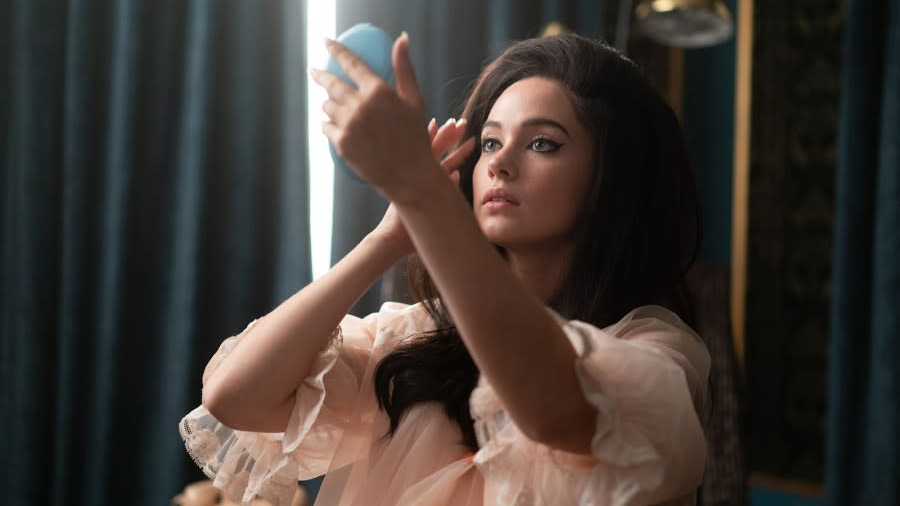
Writer-director Sofia Coppola is back doing what she does to perfection, in the moody, seductively scored (Phoenix), smoothly lit (Philippe Le Sourd) subversively uncomfortable Priscilla (2023), and that is the sophisticated, poetic, ultra-feminine and nuanced depiction of womanhood at the cusp of transformation, the painful process of female maturation in a society (and coupledom) worshiping everlasting doll-like youth.
Priscilla was 14 and Elvis 24 when they first met in a military base in West Germany, where both Presley and Pricilla’s father Captain Beaulieu (Ari Cohen) were stationed, and one could argue that a fixation on a particular young age in Elvis, himself, along with homesickness, had been the key driver for choosing someone as vulnerable and young to shape and dominate i.e. groom into becoming his eventual bride and, essentially, a captive in his Graceland mansion. The famed kitschy temple of all things Elvis (endless white carpets, porcelain figurines, et al.) had been designed as playground for the emotionally stunted king of rock-n-roll, with his royal coterie, in tow. A prisoner of his own making, he was unable to grow and develop further, under that giant bell jar that was his planetary fame.
The fact that Elvis Presley was who he was, a maddeningly talented musician, and genius performance artist, also gave him card blanche in the US of 1960s to do as he pleased, even publicly swan around with an underage girl, perpetually pill-popping, with no one really calling him out for the blatant transgression, not even Priscilla’s quite protective parents. Although her mother Ann (Dagmara Dominczyk) does discretely bring up the issue with her daughter, several times, with the latter insisting that nothing sexually inappropriate had taken place.
Still. Priscilla, the central point of this story, the forever beautiful background player, the silent arm candy, the soft-spoken princess consort, the instantly available soothing presence, had been trained to be visually pleasing and to please, carefully, almost ritually applying makeup (and her signature false eye-lashes), even before going into labour with their only child, Lisa Marie. Their daughter was quickly conceived after they were officially married, and the relationship fully consumed.
Pricilla followed Presley’s every whim and obsession, with breathless poise, from New Age spirituality, to target shooting, to karate, building a reactive manipulative streak, every so often breaking under the mounting inner pressure, which was then punished by him in a myriad of small heartbreaking ways. His father Vernon (Tim Post) also proved to be a stern taskmaster. On the other hand Elvis doted on her, which most assuredly made the bond harder to break.
There was a void, endless and dark, in the comfort of Priscilla’s existence. As well as love, disturbingly abusive yet enduring. And Sofia Coppola nailed all that queasy glamour and somnambulic psychosexual malaise to a tee.
In the final scenes of Coppola’s film, we witness the immaculately-cast Cailee Spaeny as Priscilla leaving her man-child husband (an uncanny, brilliant Jacob Elordi), now a grown woman, choosing her own imperfect self and independence, over being the mascara-heavy frozen mirror-image extension of her philandering, neglectful iconic husband. Spaeny is alike a silent-era screen siren, conveying an incredible range of emotions, without words, just with a single glance — her entire composure geisha-like and subdued.
If there is one fault I find in Coppola’s complex biopic, based on the memoirs of one Priscilla Presley, it is the reticence to push the curtain wide open in scenes that narratively necessitated it, and expose the emotional and sexual exploitation at its brutal core.
But, I understand why this was not done.
And so artistry suffered due to decency.
★★★★☆
Author: ©Milana Vujkov
 Lola On Film