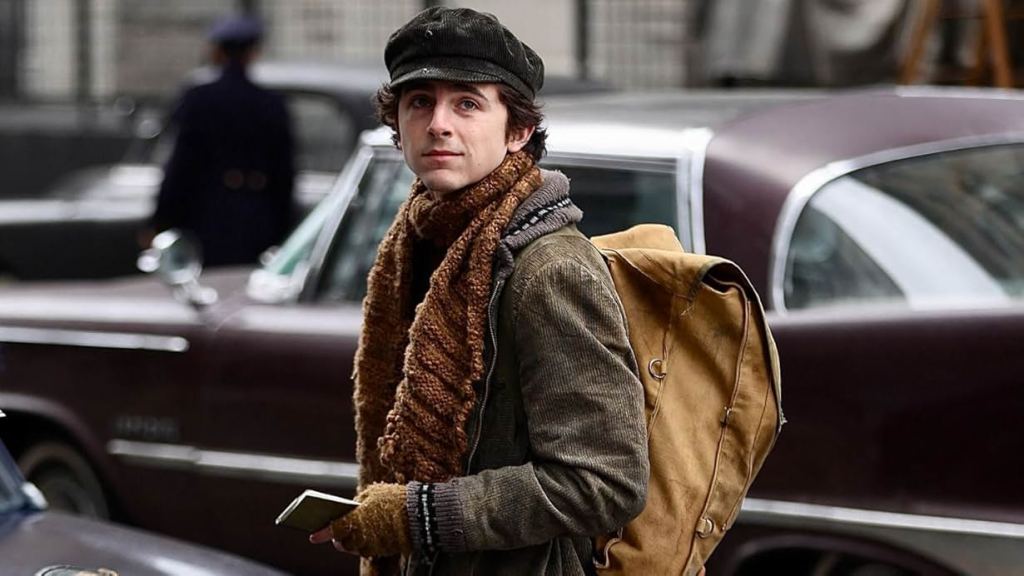
It is always a gamble to approach an iconic character in a biopic and find the complex human under layers of anecdote, conjecture, and myth — and in the case of the notoriously private Bob Dylan possibly doubly so. But, James Mangold‘s electrifying (pun intended) A Complete Unknown (2024), based on Elijah Wald‘s book Dylan Goes Electric! (2015), manages just that, despite being a pretty straightforward rags-to-riches rock tale.
This should be no surprise, as Mangold also directed the masterful (and superior) Walk The Line (2005), on the romantic partnership of Johnny and June Cash. Johnny (Boyd Holbrook) appears here, too, albeit briefly, as Dylan’s musical soulmate and avid penpal, supporting the bloody-minded authenticity of the prickly young Bob, a man of few words (unless they are poured into timeless lyrics).
Centring on the meteoric rise of the voice of a generation, from his early days on the road, Dylan’s kinship with folk pioneer Woody Guthrie (Scoot McNairy) and fellow traveller, founder of Newport Folk Festival, Pete Seeger (Edward Norton), his love relationships with the saturnine and enchanting Joan Baez (Monica Barbaro), with whom he occasionally performed, and his soulful civil right’s activist girlfriend, Sylvie (Elle Fanning), based on Suze Rotolo, whom he cheated on with Baez, and finally the notorious “artistic betrayal” of folk music dogma at Newport (by going electric) — it captures the gist of the emergence of Dylan as one of the most important poetic geniuses in art history (the only rock’n’roll Nobel Prize winner for literature) and the main reason why he never swayed from his artistic path, never repeated himself or lost in quality —his uncompromising sensibility.
Although the entire cast is exceptional, kudos for keeping the genuinely enigmatic spirit of Dylan unscathed by an inevitably abridged narration any biopic requires squarely belong to a fascinatingly dedicated Timothée Chalamet, who inhabits the legendary musician with elegance and ease, even lending his vocals to his music, allowing for his own interpretation to be led by an intuitive understanding of the man rather than mimicry or idolatry.
Despite a few glitches in its finely threaded matrix, mostly in places where it tries too hard to be Dylanesque or when it glides over issues that it should have explored further (Dylan’s introversion and lack of openness about his family or background), A Complete Unknown still delivers the goods it promises, considering the many odds stacked against it, which is a considerable achievement.
★★★★☆
Author: ©Milana Vujkov
 Lola On Film
4 responses to “A Complete Unknown”
Absolutely loved this review and couldn’t agree more. The only detail I was frustrated with was the lack of showing Dylan’s past (before getting to NY) which got reduced to a scrap book on a table in the one scene. But Dylan was literally on the set of this film, a part of production, table reads, etc so I’m assuming he’s the reason for this. How can you have a biopic though without going into the past? Most of his early successful songs written point backwards to his past before NY including the reason why he got into music in the first place. But in the end, Martin Scorsese’s film (No Direction Home: Bob Dylan) fixed that for me.
I keep checking your site to see when you’ve done a review on The Brutalist!
Thank you so much. Really thoughtful comment. You must also be a fan of Dylan, like me, so we care 🙂 Hope to see The Brutalist soon, actually.
About his family or formative years in Hibbing… I have been to Hibbing MANY times, and have relatives that went to school with Dylan, born as Robert Zimmerman. I really don’t see a reason for the pre-New York time to be part of the film.
My impression from the film and his behavior overall is that he was just a different kid/personality, like many. Most of my cousins from Hibbing left, as many teenagers left small towns to seek their opportunities and futures that would be different than their parents.
Dylan is just a moody guy. Most teenage boys can be so, but maybe for him it was to be. He may have gone to New York to to seek out musicians he admired, to be inspired, to be amongst them. Being liked and appreciated may have been important, but really famous intruded too much. All of his adult life he has not liked the intrusiveness of fame.
From all accounts, including my cousins, Dylan didn’t demonstrate talent in Hibbing. He appeared to be finding and exploring his music energy outside of his high school time in the larger world. Those he met in New York may be is what brought out his true talent, and the cultural timing brought out something in him for everyone to feel, appreciate and want.
Thanks for the comment, really interesting to know. Still believe that an exploration of this, however brief, would have given the viewer more depth of field.