It is a notorious fact of life that it ends in death, so our relationship with the Grim Reaper must have always been one of terror and awe, a mixture of fascination and repulsion, a cold fever nightmare that we know will lull us into submission, inevitably, for that one time, one day. The opposite of Thanatos is Eros, as Freud so unforgettably concurred, the unquenchable thirst for the pleasures of flesh, the creator of new flesh, the bulwark against the numbing of senses, the rotting of cells. In the centre of the two lies disease, the plague, one that is spread by touch, often in lustful embrace, and which ends in pain and suffering, and the extinguishing of light. This point of the crossing of the two is where the demon dwells, where the desperate conjure a very special type of ethereal menace — one that longs for the fragrance of youth, only in order to devour it.
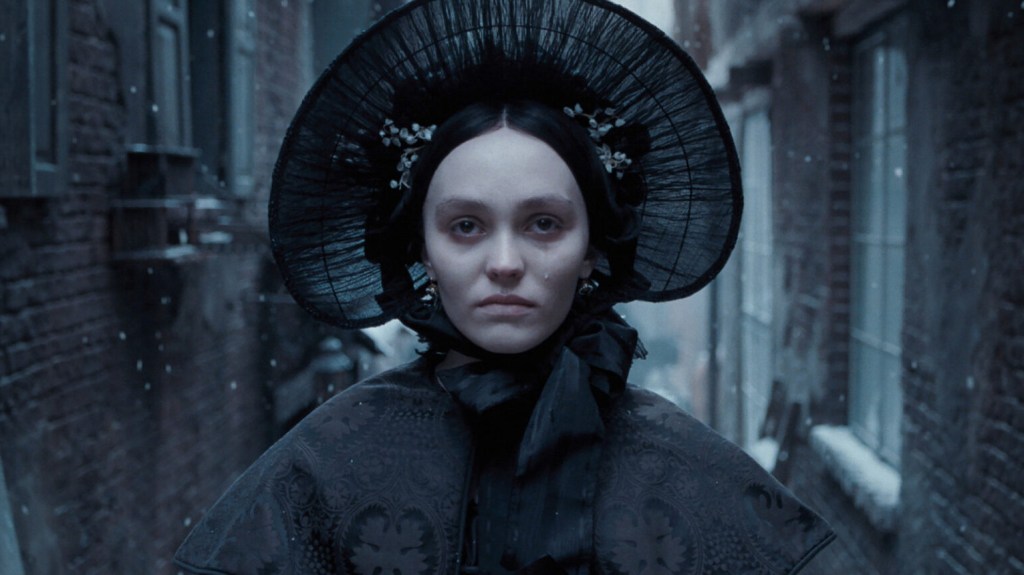
And so starts Robert Eggers‘s macabre and glamorous, perfectly shot Nosferatu (2024), with the lonely 19th century teen misfit Ellen (Lily-Rose Depp), naturally psychic, inviting a dark, ancient, eternally decaying supernatural being into her most intimate realms, precisely emphasising the necrophiliac aspects of an old tale, purposefully dwelling on them, in almost satanic ecstasy, not unlike the way Egger’s groundbreaking Gothic masterpiece The Witch (2015) approached all matters regarding the Horned One, but here with much less charm or maverick wit.
The timeline then opens with the vista of the German city of Wisburg, where Ellen, now wed to an earnest young man called Thomas (Nicholas Hoult), starts to have nightmares again, and nightly bloodthirsty visitations, erotic daydreams of death and destruction, and so is feverishly demanding her husband not travel to Transylvania, to seal a land deed with an enigmatic recluse, Count Orlok (Bill Skarsgård), who, naturally, insisted Thomas pay him a visit in his castle for the transaction. Unbeknownst to Thomas, Ellen suspects the count to be her demon lover, luring him to a certain death, while Thomas’s boss, the devilishly impish Herr Knock (Simon McBurney), turns out to be a most devoted disciple to the old demon in question. Still, Thomas needs the money to keep his family afloat, and travels south, where he is greeted by a landscape that reeks of hidden terrors. While his young wife pines for his presence, she is left to the custodianship of another enamoured young couple — the Hardings (Aaron Taylor-Johnson and Emma Corrin), and their angelic children, all of whom will be collateral victims to what shall inevitably occur. As will the entire city of Wisburg.
A remake of F.W. Murnau‘s Nosferatu: A Symphony of Horror (1922), yet lacking in the original’s black humour, resorting to self-irony, instead, this fascinating story of death and desire slowly succumbs to becoming the very disease it depicts, mesmerised by its own beautiful, soulless emptiness, fully open to the seductive corruption it so masterfully and pedantically conveys. Where the vampire chic and romantic tragedy in Francis Ford Coppola‘s camp incarnation of Dracula (1992) triumphs (the original Nosferatu was an unauthorised adaptation of Bram Stoker‘s famous novel), Egger’s saturnine Count Orlok, a large beast of a man, moustached, dishevelled, and bedecked in furs, is somewhat morosely static, stuck in the Carpathian mountains and marshes, eagerly awaiting his own proper dramatic tonal footing. He spouts verse in ancient Dacian, engages in Solomonari ritual, flirts with Enochian magic, is in stand-off with local Romani tribes on his land, and wages war with the Orthodox Christian priests and nuns, the only ones with the correct antidote to the malady he inflicts, but still not powerful enough to banish him. Yet, despite this incredibly fleshed-out world he inhabits, we know close to nothing about him, except that he is in a state of bodily decomposition, and sleeps in his personal stately crypt during the day.
It does not bode well for a narrative about existential horror to under-develop the actual source of the horror, and focus only on the consequences of its existence. If Orlok personifies the plague, which is a force of nature, he still should have an origin story — as all diseases do.
It would be fair to say that despite the above-mentioned reasons for my less than ample ranking of an otherwise astonishingly visually accomplished film (cinematography Jarin Blaschke, production design Craig Lathrop, costume Linda Muir), I also truly admired all aspects where this incredibly striking spectacle outdid all other films of the ilk, and set new standards for authentic setting and atmosphere, as well as lack of shortcuts when it comes to the minutia of a complex re-telling of myth. In terms of thespian prowess, all the undoubtedly talented cast has a strangely theatrical appeal, with the exception of a highly spirited and electrically cinematic Willem Dafoe, as Prof. Albin Eberhart von Franzh, the alchemist and demon slayer called to the rescue — and Lily-Rose Depp’s Ellen, in her sacrificial, highly aestheticised, final embrace with Death.
An impressive yet emotionally anaemic work (pun expected).
★★★☆☆
Author: ©Milana Vujkov
 Lola On Film