Published in: 2024, Patterns of Miscommunication in Contemporary East-Central European Cinema
From the Editors’ Introduction to the volume: The series of chapters is opened by Milana Vujkov’s reflection on the emotional “paralysis” that took hold of her while she prepared to publish on her blog a review of an impactful recent film about the post-Yugoslav conflict, namely Quo Vadis, Aida? (directed by Jasmila Žbanić, 2020). The author delivers a powerful meditation on self-censorship and dilemmas of engagement in polarised public discourse within post-conflict societies while recounting an intimate, deeply moving, yet sober journey across the shattering memories of life in Serbia in the 1990s. An instinctual reaction against a state of re-traumatisation, her reluctance to engage in a public debate marked by discord and denial is not without raising the issue of the consequences of silence, which is detrimental to opening communication channels between different nations and political options. Most importantly, Vujkov’s text also provides a deeply engrossing meta-framework for all subsequent contributions, problematising the role of film criticism and film studies in the discourse on (and generating from) East-Central Europe.

Publication: Patterns of Miscommunication in Contemporary East-Central European Cinema
Editors: Denisa-Adriana Oprea, Liri-Alienor Chapelan
Publisher: COMUNICARE.RO 2024
Proceedings of the Patterns of Miscommunication in Contemporary East-Central European Cinema International Conference (Bucharest, 28-29 September 2023).
Excerpt: https://edituracomunicare.ro/pdf/pdf_639.pdf?id=1733750521
The Unpublished Word (Manuscripts Don’t Burn) — On Censorship, Film Writing & Trauma
Abstract: Examining the impact of personal, familial, and collective trauma on individual vocational expression, and the implications of self-censorship, this paper aims to address deeper dilemmas of engagement in polarised public discourse facing professionals in post-conflict societies.
Keywords: self-censorship, trauma, film writing, civil war, propaganda, group psychology
Author: © Milana Vujkov. Independent Film Scholar.
Also published at Academia.com
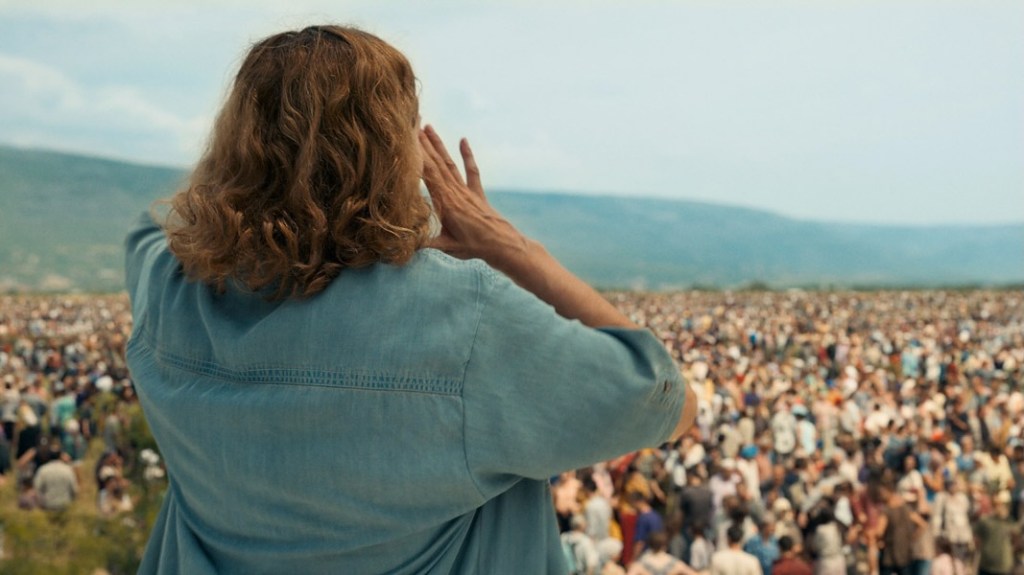
[header image: Quo Vadis, Aida? (2020), dir. J. Žbanić]
When evil breaks at any point into the order of things, our whole circle of psychic protection is disrupted.
(C. G. Jung, After the Catastrophe, 1945)
(Re)titling my paper addressing self-censorship with possibly the most often quoted literary line on the indestructibility of the written word, conjured by Mikhail Bulgakov’s version of the devil in The Master and Margarita (Bulgakov, 1967, p. 326), seems to have served as an amulet of sorts in helping me strengthen an argument, one I had struggled with for quite some time.
This paper was initially constructed as a chronology of the paralysis which occurred when I was preparing to publish my five-star review of Jasmila Žbanić’s Quo Vadis, Aida? (Bosnia and Herzegovina, 2020), a powerful, harrowing account of the Srebrenica massacre — to an international audience, on my Lola On Film blog. It was originally titled: To Publish and to Perish? Or, Why I Did Not Release My Film Review. As the revising of my original title suggests — the density of the theme required a subsequent parallax view. By allowing my perspective to slip slightly laterally and away from the direct inspection of my subject, I found the obscured path into the centre of this frustrating and seemingly endless psychological maze. It was in the cacophony of conflicting thoughts that I arrived at a moment of epiphany. Steering the wayward ship to its metaphorical shores, I will endeavour to peel layer upon layer of external circumstantial content, as to arrive at a deeper understanding of the professional choice I made in not wanting to publish a film review. Through self-analysis, I also wish to speak on a significantly more important theme: the censoring of one’s authentic voice as a societal trend. The idea of self-censorship as both self-preservation and a political stance of non-engagement made me ponder on the consequences the unwillingness to talk about dangerous but important topics could have — not only on one’s personal integrity and artistic authenticity, but on the quality of artistic output in national, regional, and international cultural spaces. Something Jung considered to be the social significance of art (quoted in Hauke, Alister, 2001, p. 49) — “educating the spirit of the age, conjuring up forms in which the age is most lacking.”
In the online Cambridge Dictionary, we find self-censorship defined as self-control — a case of courtesy, motivated by a wish not to offend, without an external prompt. The Oxford Reference Dictionary is less forgiving, emphasising the propensity towards conformity. Crowd-sourced Wikipedia finally arrives at the raw nerve of the term — the element of fear, followed by a list of professions prone to acts of self-censorship. Not surprisingly, film authors and journalists are presented as amongst the most vulnerable. The text also quotes Article 19 from the United Nations Universal Declaration of Human Rights, which would be worth mentioning in this paper, lest we forget that speaking freely, without fear of reprisal, is officially deemed of the highest civilisational value: “Everyone has the right to freedom of opinion and expression; this right includes freedom to hold opinions without interference and to seek, receive and impart information and ideas through any media and regardless of frontiers.”
A podcast I often listen to, This Jungian Life, explored truth-telling in one of its recent episodes, Speaking Truth: Is It Venom or a Cure? (This Jungian Life, 2024) — and the symbolism of the Scapegoat (past sins, group sins), as well as the Cassandra complex (prophecy). Its three Jungian analysts and hosts talked about the positive and negative aspects of ‘speaking truth to power’, and the many ways (Lee, J.R.) “truth can be a Trojan horse […] how facts are weaponised when infused with the spirit of accusation.” Struck by the sheer intensity of the anxiety I felt while my index finger was hovering over the ‘publish’ button after I completed the Aida text, I was faced with the complexity of my own motivations, doubting both what I had written and my reasons for publishing the review.
When talking about self-censorship, one has nowhere else to start except with the idea of the self as the managing system of one’s own creative output. This entry point of self-reflection on one’s own writing process is crucial in order to reach an understanding on why an author would not allow their voice to be heard. “I am more willing to risk imprisonment than curtail my intellectual freedom,” said Edward Snowden in Laura Poitras’s game-changing Oscar-winning documentary Citizenfour (2014). I am far less courageous than the CIA whistle-blower and free-speech champion. However, what I am unwilling to do is write insincerely. That trait, in itself, does not fit particularly well in the definitions of self-censorship, as they all imply a falsehood, a distortion of an authentic voice.
It takes me some time to start the process of writing. The contemplation of an idea is prolonged, as is the editing afterwards. However, once I have the text solved in my mind, I am able to write it up quite quickly. If I am not satisfied with the results, I do not publish them. Plenty of drafts in my virtual folders attest to that, the proverbial ghosts of creations past. If I am happy with a text, however, no matter how controversial or inconvenient its argument might be, I go ahead with releasing it. My only concern is that the quality of the written word and the integrity of the ideas behind it stand solid. This kind of ‘manuscript’ I find to be an indestructible shield. All of this had been subverted in the process of reviewing Žbanić’s Aida.
Firstly, it took me a while to view the film. I watched it on demand via Amazon UK late March 2021. By that time, it had its European theatrical run, but not yet a theatrical release in Serbia. When I saw Aida, it was already an Oscars 2021 nominee. This was in the lead up to the ceremony, which, due to the pandemic, was held on 25 April that year — a much later date than usual. It did not go on to win the Academy Award in the Best International Feature Film category, but it did triumph at many other international festivals and showcases — such as the International Film Festival Rotterdam (Audience Award), Gothenburg Film Festival (Best International Film Award), European Film Awards (Best Film, Best Director, Best Actress), and Independent Spirit Awards (Best International Film). When I finally did watch it, the experience was profound. On my Facebook profile (2021, March 23), I wrote a short note, praising the film, voicing concerns regarding its reception in parts of the public (and media) in Serbia:
[…] Artistically, it’s absolutely outstanding. Politically, I did not find fault in it, except a few very minor objections. Emotionally, it was shattering. It’s absolutely not anti-Serbian, as some in Serbia accuse it of (largely having not watched it). It simply shows events as they unfolded. If anything, it’s highly critical of the actions (or rather inactions) of the UN, present in the base at Srebrenica in July 1995. The portrayal of Ratko Mladić in it is jaw-droppingly accurate, in embodiment, and word for word, all of which can be found in publicly available video documents. It’s truly a masterpiece.
The review of Aida turned out to be an equally prolonged process. As there was a media storm brewing in Serbia surrounding it pre-Oscars,[1] I did not want what I wrote to possibly be weaponised, or taken out of context. So, I decided to wait, and publish the review on Srebrenica Memorial Day, 11 July 2021, as a way of remembrance. The review was completed on time. But, then, I simply failed to publish it. It underwent several edits in the ensuing months. Finally, I realised I simply had too strong a resistance for it to go forward. So, effectively, I gave up on it. The last edit was in July 2022 — there were 25 edits in total. I still believe it is one of the most heartfelt reviews I ever wrote. This is its final paragraph: “Whoever lived in the chauvinist squalor that was the 1990s in the Balkans, a time when avenging ghosts and delusional violent men ravaged these lands, knows the truth when they see it. There may be many paths to it, as there are to the allegorical Rome in the title. But there is only one destination”.
Now, let us tackle the foul weather in popular discourse at the time of the premiere of Žbanić’s film. Another film on the topic of genocide in the region of ex-Yugoslavia was released in parallel to Aida — Predrag Antonijević’s Dara of Jasenovac (Serbia, 2020), based in World War II, and the fascist Independent State of Croatia. It dealt with the horrors of the Jasenovac concentration camp under the Ustaša regime which operated its own extermination camps for Serb, Jewish, and Romani people, and political dissidents. Both films were their country’s representatives at the Academy Awards 2021 — Aida for Bosnia and Herzegovina, and Dara for Serbia. Unfortunately, one film had been universally lauded, while the other — thoroughly lambasted. The worldwide critical reception for Quo Vadis, Aida? was exceptional. Peter Bradshaw in The Guardian (2021) praised its “tragic power,” Mark Kermode (2021) called it “profoundly moving”, it was a Critic’s Pick in The New York Times (2021), described as both “harrowing and rigorous.” Brian Tallerico for RogerEbert.com (2021) called it “a deeply humanist and moving character study.” Scholars Aida A. Hozić and Srđan Vučetić wrote an opinion piece for Al Jazeera (2021) on “why Quo vadis, Aida? deserves an Oscar.” The international reviews for Dara, unlike the ones for Aida, were scathing. Jay Weissberg in Variety (2021) branded it “a Holocaust movie with questionable intentions”, in LA Times Robert Abele (2021) concluded that “it regrettably aims in settling scores,” in The Jewish Chronicle Linda Marric (2021) assessed that “the film feels misjudged and gratuitous.” One of the few that praised the film’s effort was Anna Smith for Deadline Hollywood (2021): “Despite some heavy-handed moments, it’s hard not to be struck by the horror on display.”
At the height of public controversy, late January to early February 2021, I haven’t yet watched Dara of Jasenovac. In fact, few in Serbia have, as it had a very small premiere in Gračanica, Kosovo and Metohija, 25 November 2020, and then went on to a US theatrical release. Only in late February 2021 did it have its television premiere on RTS, the public radio and television broadcasting service. Nevertheless, I read all the reviews of Dara I could find online. Some seemed to be unnecessarily cruel, particularly as the film covered such a traumatic topic. One would expect at least a modicum of sensitivity in the delivery of a negative review. If there were personal politics involved in the international reviewers’ assessments of Dara, it is the writers’ prerogative. Nevertheless, my reflex of distress at the brutality of some of the texts was born out of decades of enduring stereotypical (often abusive) coverage regarding Serbs and Serbia in Western corporate media. Since the 1990s, this became par for the course, and I always found it unquestionably problematic. Not least as the loudest critics did not hail from historically blameless societies. There was, of course, plenty of cause for harsh criticisms of Serbian state politics and the nationalist slant of Serbian society during the civil war in ex-Yugoslavia. However, the concept of collective guilt frequently holds the seeds of dehumanisation and persecution, leading to acts of collective punishment. Their severity, in turn, very much depends on the geopolitical position and power of the country in question. Furthermore, not all countries are equal in the eyes of international law. The great psychiatrist and Holocaust survivor Viktor Frankl, in his speech in 1988, on the occasion marking Austria’s annexation by Nazi Germany 1938, characterised the idea of collective guilt as an entirely fascist concept, a continuation of Nazi-ideology — despite his harrowing experience in Auschwitz (Noetic Films, 2018). Or, perhaps, exactly because of it. Branding a nation as ‘guilty’ is a slippery ethical slope even in the most extreme of historical circumstances — such as was the Third Reich. C.G. Jung (with far less of a personal stake than Frankl), collectively condemned the German people in his otherwise fascinating account of the rise of Nazism in his After the Catastrophe (1945). Assigning collective blame often serves to deflect from one’s own culpability, something one could suspect to have been the case with Jung.[2] Regrettably, we now live in highly punitive times, a zeitgeist which aligns itself with harsh moral judgement — not Frankl’s unwavering humanism. If we are to trust Frankl (and I certainly do) — we therefore live in fascist times. There is, however, a strong sense of shared responsibility in every society, and for that to be truly addressed, in the end — it must come from within the nation whose individuals had committed mass atrocities. A war crime does not equate collective guilt, but there is personal collusion in our silence about it, as well as in voting for politics inciting violence and hatred.
The furore surrounding Dara of Jasenovac cut straight into the unhealed wounds of Serbian society. Even more so as no feature film until Dara, similarly to Aida in the case of Srebrenica, had yet attempted to fully portray the horrors of Jasenovac. This statement, made by Dara’s creators, had been disputed in the press, but it is not incorrect. Although there were a number of documentaries that dealt with the subject during the time of the Socialist Federative Republic of Yugoslavia, most prominently, the powerful and harrowing Blood and Ashes of Jasenovac, directed by Lordan Zafranović (1983), no feature films to date addressed the Jasenovac camp except in an indirect way.[3] Reasons for this are manifold, too broad for the constraints of this paper. Nevertheless, in the aftermath of the Dara scandal, I felt the need to comment publicly. The text below, which I posted on my Facebook profile (2021, February 4), I believe carries a great deal of weight regarding the topics discussed in this paper. Therefore, I will quote it (almost) in full.
[…] Still haven’t seen Serbia’s Academy Awards entry Dara of Jasenovac, because of its late release date in Serbia, but the controversy surrounding it incited by one Variety review (pretty brutishly branding it propaganda) already makes it difficult for it to be viewed on its own merit, even for me, let alone anyone who’s not from Serbia. And that, in itself, is tragic. However, any film about the topic, masterpiece or not, would have a great burden to bear. Perhaps this is why so few were made (one outstanding doc by Lordan Zafranović, no feature films until now). Not many people in Europe, and even fewer in the US, had ever heard of Jasenovac concentration camp. The reason for it not being spoken of in the same breath with other WW2 death camps in Europe was mostly due to Yugoslav post-war interior politics — suppressing painful memories, fear of retaliation, bid for unity, a need to make some sort of gruesome numbers balance in atrocities. So, the shocking scope of it was muted to ease multiethnic tensions. The result was that a wound of this magnitude was left untended. Jasenovac was the central extermination camp in NDH — the fascist Independent State of Croatia, and one of the largest, bloodiest concentration camps in Europe, in which more than half of the people murdered were Serbs, but it also had a great number of prisoners that were Jewish, Roma, communist. […] Each nation and religion in the Balkans has its own heart of darkness which it refuses to fully investigate. This is a part of the world that has been under some sort of foreign occupation for almost a millennium, and never had peace for more than a few decades in a row. The Islamic Ottoman Empire enslaving the Orthodox Christian nations of the Balkans (Greeks, Serbs, Bulgarians etc.), for centuries, with its extremely cruel practices, left a heavy mark, which continues to this day in simmering, deadly Islamophobia. The Austro-Hungarian Empire with its entitled colonial assimilation of Catholic Slovenia, Croatia, and in the end, multiethnic Bosnia, perhaps did not cause WW1, but certainly, ignited it. The legacy of the Independent State of Croatia in WW2 did not go through a process of reckoning that any other genocidal fascist regime in Europe went through after the war, as Croatia immediately became a part of multiethnic socialist Yugoslavia, and the dead were not properly mourned. The Serbian nation is yet to fully comprehend the horrors that have been done in its name in the 1990s, as their victimhood has been disrespected for such a long time, and continues to be, so a good percentage of the populace refuses to acknowledge the extent of their own complicity. Passions are high, and blinding, it sometimes seems to me that no one who had their family slaughtered by any side, at any time in history (which is all of us here), can take a single breath without overreacting and lashing out further, while denying their own nation’s or religion’s misdeeds. Thus, we are collectively silencing the many important voices who speak out on behalf of all victims. […]
Although I still stand by every word I wrote, professionally speaking, I should have watched Dara before I made any comments about its critical reception. The timeline of events and its jumbled release made me (symbolically) fume at an empty screen. There is something in this warped chronology of commenting en masse on films that one has not seen, substituting art for history and reality for art, that has all the hallmarks of a frenzied behaviour peculiar to crowds, observed by the French social psychologist Gustave Le Bon[4] in the late 19th century, quoted by Sigmund Freud in his 1920s writings on mass psychology (Freud, 2004, p.21), highlighting “certain ideas and feelings which do not come into being, or do not transform themselves into acts except in the case of individuals forming a crowd.”
Subsequently, having seen both films, and observed the narrative weaknesses of Dara, I can fully understand my colleagues’ low scores — although not some of their unbridled vitriol. Was it a government funded project to counter the effects of Aida? Fedor Tot, in his piece for the New East Digital Archive (Tot, 2021), mentions “the €2.3m in the film’s budget from the Serbian government, a figure that far outstrips other Serbian film productions.” Frankly, it would be strange if a film on Jasenovac, a defining tragedy of the Serbian people, had not been given ample funding from the Serbian state. But, what the motivations of the people who took part in this decision were, I would not know. If it was done for a regional ‘settling of scores’ and countering the ‘Aida narrative’, it would be the most cynical use of one’s own tragic history. The fact that it also gives rise to more examinations of historical events in a region rife with historical revisionism — in this case, Croatia, in particular — is not lost on me.
On the other hand, Aida, an infinitely stronger film, is not without its political connotations. The presentation of the Bosnian Serb Army I found strangely uniform in their unwavering brutality. This was inevitable — as it is a film about Srebrenica, a heinous war crime. However, characterisation could have been approached differently. The civil war in ex-Yugoslavia had been a conflict of incredible complexities, with grave crimes committed across the national divide, albeit in different proportions in relation to the number of casualties — still the most contested point for Serbian nationalists, accompanied by genocide denial.[5] Essentially, both films could be seen as propaganda, if we insist on the political value of a film. Except one is a masterpiece, and the other is not. It is the subtlety of Aida juxtaposed with the heavy-handedness of Dara that creates the crucial difference in the spectator’s perception of on-screen events. Finally, as iconic works like Sergei Eisenstein’s Battleship Potemkin (1925) and Gillo Pontecorvo’s The Battle of Algiers (1966) can attest to — excellence in filmmaking does not necessarily equal the absence of propaganda. And as Daniel Frampton points out in Filmosophy (Frampton, 2006, p. 169), “the route to interpretation should always be via the whole film.”
In regional terms, what followed the Oscars ‘clash’ of the two films was a raw, frenzied, online spat (see Fig. 1) — a cacophony of voices throwing insults at one another (and at reviewers), followed by a political and societal analysis of the ‘battle of films.’ The entire heated exchange lasted for weeks in regional media, online portals, and social media. In Women’s Cinema as Counter-Cinema, Claire Johnston, feminist film theoretician, quotes German author Hans Magnus Enzensberger, in the New Left Review, no.64 (Thornham, 1999, p. 36): “There is no such thing as unmanipulated writing, filming or broadcasting. The question is therefore not whether the media are manipulated, but who manipulates them. A revolutionary plan should not require the manipulators to disappear; on the contrary, it must make everyone a manipulator”.

In due course, the world of social networks and digital platforms had truly made keyboard revolutionaries and DIY Machiavellis of us all. The question of who the puppet-masters are behind individual manipulation still remains, as participatory propaganda (Asmolov, 2019) slowly engulfs online discourse. In the case of the regional ‘cinema war’, the analysts’ lines were often drawn not far from the vox populi ones, with only a small number of impartial voices. BBC Serbia’s Jelena Maksimović (2021) wrote of the “post-Yugoslav film discord”. In the XXZ regional portal (2021), Ahmed Isanović, from Bosnia and Herzegovina weighed in on “why Quo vadis, Aida? [was] a success, and Dara of Jasenovac a failure”. Mladen Mrdalj for Talas, Serbia (2021), analysed the “cinematic war for context”. Josip Mlakić in the Croatian Express (2021) wondered if “Dara of Jasenovac [was] the answer to Quo vadis, Aida?” Libyan-born Bosnian writer and photographer, Sumeja Tulić, for Brooklyn-based Hyperallergic, compared the two films’ “different tactics on filmic representation of war crimes”, praising Aida and criticising Dara. In a rare balanced text on the topic, Kristina Gadže, a journalist from Bosnia and Herzegovina, for the Dealing with the Past portal (2021), concluded that “a divided society makes it impossible to see films as art and stresses the existence of catharsis only in case of one’s own people, not in case of other nations.” Finally, Vesna Knežević, Serbia, for RTS online (2021), remarked, with dark humour, that “[this is] about two films and not two war operations,” noting that “the public in former Yugoslavia treated [the films] as an extended arm of war”. Audiences in Serbia, Croatia, and Bosnia (and their diaspora), further took to pumping up or dragging down Aida and Dara’s audience film scores on IMDb and Rotten Tomatoes, to the point of IMDb temporarily suspending commenting and audience ratings for Dara (Bogdanović, 2021). Claims of a neglected victimhood became increasingly loud online in Serbia, spurred by an unwillingness to understand that a fictional depiction of an event can and should be open to cultural and artistic scrutiny, and is not equivalent to the scrutiny of the event itself. The insensitivity of the reviews made this point harder for people to digest. As both films speak of the unspeakable, the preponderance of disposable and often crass words surrounding their release made the entire public discourse on two films thematising genocide entirely macabre.
The ugliness of the online ‘war of films’ left a bitter aftertaste. As much as it influenced my reluctance to publish the review of Aida, it was not at all instrumental in my decision not to review Dara. I absolutely could not push myself to write anything about it, speechless that such a topic had not been given maximum artistic attention from its creators, and that the result was so disappointing. A hard watch, cinematically uneven, narratively underdeveloped, Dara of Jasenovac taught me a valuable lesson on my own professional limitations.
This realisation, in turn, brings me to the deepest layers of analysis, far more visceral and intimate than a virtual regional spat — the shattering memories of life in Serbia in the 1990s, witnessing first-hand the bloody breakup of Yugoslavia, the country I once called my own.
Quo Vadis, Aida? is an unflinching account of the July 1995 Srebrenica massacre — the murder of more than 8,000 Bosniak Muslim men and boys by units of the Bosnian Serb Army, under the command of Ratko Mladić. A depiction of historical trauma, a crime against humanity, as well as a story of a mother, working as a UN translator, desperately attempting to save her family from slaughter, facing an ocean of appalling neglect by the international community, negotiating often dizzying displays of disconnect and bureaucratic rigidity by the UN Dutch peacekeepers guarding the Safe Zone, protecting the Bosniak Muslim population in Srebrenica, which was now under attack. That tidal wave of impending violence, depicted so surgically on screen, I could recognise in the smallest detail, although in the timeline of the civil war in ex-Yugoslavia, I was not living where this devastation occurred. I was in Serbia. And if I had been following the official narrative in my locality, my view of this atrocity would have been entirely distorted. In the minds of some people — it still is. But I knew of this horror. I could sense it in people’s callous attitudes towards another’s suffering. This stubbornness in promoting exclusively one’s own victimhood, blinded to anyone else’s. On an individual level, there were many dissenting voices, but they were too weak in aggregate to prevent the mass mayhem. It took time for dissent to turn the tides of war. As for me, all I knew to be true about my country and my countrymen, their heroic, tragic past, had been perverted and transgressed.
I wrote about the conflict before, both as a scholar and as a writer. I even programmed a film festival on the very topic, in London, which I named No Exit: Essential Serbian Cinema, 1995-2000 (see Fig. 2). This was at the Institute of Contemporary Arts, 4 -16 November 2005. My introduction to the short season of Serbian feature films and documentaries of the period was unequivocally aimed at the sense of personal responsibility in the face of hard historical choices — choices that absolutely required both a public and private positioning:
No Exit presents the state of Serbian (and Yugoslav) society throughout the decade of the nineties and serves as an appropriate metaphor for a nation’s inner battle. It was devised as homage to ordinary people fighting valiantly to preserve the last shreds of decency in a society over-powered by fear. […] In their distinctly different styles, [these films] depict a universally human vulnerability, the irreversible imprint of choices individuals are forced to make in the face of collective historical circumstance.

If I was able to speak on the conflict in a very public capacity almost fifteen years ago, then why was the review of Aida a Rubicon I could not seem to cross? Maybe it was because I was back in Serbia, after two decades in the UK — in an atmosphere of renewed tensions, a dire and deliberate removal of nuance that marks the existence of tyranny, as per the quote widely attributed to documentary filmmaker Albert Maysles. Although my review could have easily disappeared in volumes of cinema content online, it could have also triggered the possibility of threats, sometimes in terms of bodily harm. Such a response born from the darker side of the outrage spectrum is not unheard of in this region, when tensions run high. Amongst a portion of the populace in Serbia and Republika Srpska, general Mladić is considered a hero, and his indictment for war crimes — a fabrication. Looking around me now, it seems the 1990s never ended, rather went underground, emerging with lesser ferocity but equal mindlessness, as there are generations that never knew of the time before the civil war. Inheriting a shared post-Yugoslav culture, but also post-conflict patterns of miscommunication — “a competitive mistrust”, as Croatian journalist and novelist Slavenka Drakulić termed it in her Café Europa Revisited (2021) — the young now live in a regional atmosphere of a perpetual “fuelling of fear,” not having witnessed the past. “Nationalism is an ideology that needs an enemy; […] if there is anything to learn from the wars in the former Yugoslavia, it is that a step back into our own past is always possible.” (Drakulić, 2021, pp. 9, 95).
Thus, my seemingly excessive anxiety in facing a public backlash in the current atmosphere of discord and denial might have had an obvious cause — a state of re-traumatisation. In that sense, I had reached a point of exhaustion with the very idea of conflict — this rift that continues, this hatred that never ends. A cycle of violence that is a perpetuum mobile. An attitude which I started to view as an addiction to conflict — one which I saw no way to meaningfully oppose. The works of American psychologist James Hillman on conflict and violence gave me context, particularly his profound A Terrible Love of War: “To understand war we have to get at its myths, recognise that the war is a mythical happening, that those in the midst of it are removed to a mythical state of being, that their return from it seems rationally inexplicable, and that the love of war tells of a love of the gods, the gods of war” (Hillman, 2004, p. 9).
In the civil war in ex-Yugoslavia, this red mist covered us all, as we began to live in mythic time. Historically, Serbia nurtured its national myths as a way to survive, particularly under the five-centuries long Ottoman occupation. Nowadays, I am more convinced that what I am witnessing around me is a built-up existential anxiety searching for an anchor in a chaotic, corrupt society. In an ether filled with distinctly poisonous yet seductive narratives, it is not difficult to ingest a story, latch onto it, finding one’s sanctuary in the immovability and ecstasy of myth. Soothing an individual angst by dissolving one’s ego in collective reverie. Wilhelm Reich, in The Mass Psychology of Fascism, views all movement towards mysticism as reactionary (1970, p. 24). I disagree, finding this view ideological and rather absurd, as well as Eurocentric — inapplicable to many societies, particularly indigenous ones. Some myths were equally manufactured by revolutionaries, weaponised to suit an agenda, precisely because the impact of myth is so powerful. Furthermore, myths that stand the test of time can impart great wisdom and psychological healing — a connection to oneself, one’s locality, the Earth, and all humanity. However, Reich was right in concluding that “in their subjective emotional core the notions of homeland and nation are notions of mother and family.” (1970, p. 56) Belonging to a tribe fills a gaping wound entirely personal in nature. And Serbia, the Western Balkans, and indeed, Europe, present no exception to this trajectory. In a globally connected world, polarisation is the trend. Groupthink is encouraged. Divides are not only national, they are ideological, religious, aesthetic, foundational. Trenches have been dug, stances are unyielding, echo chambers impenetrable, dialogue between opposing fractions virtually non-existent. Compassion for ‘the Other’ seems to have left the human heart.
When talking about the rise of violence on-screen in an increasingly permissive world, American film critic and author Molly Haskell, in her From Reverence to Rape (Haskell, 1987, p.28) talks of audiences which have “succumbed to a kind of emotional laziness and passivity, a state in which only violence can rouse us.” This rings true of the current state of Serbian society. There seems to be an overall sense of malaise — thus, an imaginary battle, an online crusade, promises to inject energy, a feeling of agency and purpose in a life lacking meaning. Maybe this is all that it is — a war for war’s sake, and maybe this is why, in the end, I could not bring myself to contribute to it. Perhaps I felt that the best way forward is simply to offer no narrative. No point of view. No more fuel. Because, a review is never simply a review. It is received as a political statement, a provocation, and in some quarters — a part of an orchestrated campaign. Regarding this predicament, I particularly relate to something Umberto Eco wrote in his Foucault’s Pendulum (Eco, 1989, p.57): “[…] the moment you pick up the clay, electronic or otherwise, you become a demiurge, and he who embarks on the creation of worlds is already tainted with corruption and evil”.
Having travelled through this labyrinth of Sturm und Drang, I did finally reach the monster at its centre. A cellular level of understanding of my wretched paralysis. Which, I now firmly believe, had been directly connected with an inherited dread, a reflex, an ingrained bodily reaction, an instinctual turn towards survival. The in-depth exploration of my action — or rather, inaction, brought me to the realisation that my decision to not publish the review of Aida was neither rational nor emotional. It had been purely instinctual. In the case of highly politically charged topics in the Balkans, ones that haven’t reached a resolution (for decades, if not centuries), this was the impulse — to completely and immediately disengage.
When I was a nine-year-old I had a dream of a map of Yugoslavia. It was like the one we had in school, a large map, covering the wall of our classroom. In the dream, I was given a birds-eye view of the land, suddenly exploding at its centre, in Bosnia, and a geyser of blood shot through, drenching every inch of surrounding geography. I woke up distressed, and went to my maternal grandmother, who, after hearing it, quietly said: “There will be another war.” Her husband, my grandfather, had been tortured by Horthy fascists in the Second World War, she witnessed him being dragged through the streets, while she was running behind him, pregnant. Then she had to identify his body on a heap with others who suffered the same fate. This was at the very beginning of the war, in 1941. My mother doesn’t have a memory of her father, except for the story of his martyrdom. My own father was a teenage partisan, a young socialist. He fought the fascists, and survived the war as victor, and then became a political prisoner in the 1950s, at Goli Otok, the Yugoslavian version of the Soviet Gulag, a notorious prison island — all due to a few sentences he publicly said. For him, the prison was far worse than the war. It brought a disillusionment in his ideals. He always told me to be true to myself, but steer clear of involvement in politics, as it was an extremely dirty game. His younger brother was also a boy soldier who ran away from home to join the partisans, and caught perhaps one of the last bullets of that war in 1945. Their mother, my paternal grandmother, went in search of her son and his remains, found them, and brought him home to be buried. These are just the stories of my most immediate family. Ones which I grew up with.
Speaking of intergenerational trauma, in The Washington Post’s “How does trauma spill from one generation to the next?” (Zimmerman, 2023), the idea of it being embedded in our DNA, clinical psychologist Ed Tronick remarked that “it’s not the traumatic experience that is passed on, it’s the anxiety and world view of the survivors […] a view that the world is a dangerous place where terrible things can happen anytime.” And in the case of my family and upbringing, I find this observation to be incredibly accurate. In fact, I already knew the stories of both Aida and Dara before I saw the two films — layer upon layer of them. My inherited family experience was mirrored in both those films. There are so many of us in this region who claim these stories as heritage. Until 1991, this history of violence seemingly did not have any impact on my life, except for a distinct feeling of foreboding, fated to be confirmed by real-life events. This experience further transmuted into a lifelong quest for ‘survival’. This feeling of dread never leaves us. It lodges in our bones, chilling and unforgiving, resurrected every time there is a sense of closeness to a particular form of belligerence. In publishing the review of Aida, there was a part of me that was convinced that it is inviting this kind of violence to my door.
EPILOGUE
[…] and their hatred will be perfect, like a shining diamond, like a knife, like a mountain, like a tiger, like hemlock. Their finest art.
(Charles Bukowski, The Genius of the Crowd, 1966)
In conclusion to this meditation on the futility of intellectualising an ingrained instinctual response, I would like to spare a thought on the wider consequences of silence. The lack of political engagement in the public sphere that is often present in professionals who hail from countries formed following the civil war and breakup of Yugoslavia frequently has a bloody personal history behind it. I believe this must also be the case with other previously war-torn, conflict-ridden societies. Keeping quiet is often how people stay safe — and sane. This is not only deeply saddening, but detrimental to building renewed, healthy regional and inter-societal relations — opening channels of communication between different nations and political options. As for me, after this process of self-reflection, if I were to describe the aftermath of my self-censorship fiasco, with a final word, it would likely be sorrow, rather than guilt. Although these two emotions exist in the same space of disengagement, and I feel them in equal measure. Nevertheless, one cannot live without hope. Thus, I end with an excerpt from Ivo Andrić’s Nobel-prize winning The Bridge on the Drina, a wise advice for overcoming the enormity of history and its power in shaping our own individual destiny: “Every human generation has its own illusions about civilisation; some believe they are taking part in its upsurge, others that they are witnesses of its extinction. In fact, it always both flames and smoulders and is extinguished, according to the place and the angle of view” (Andrić, 1963, p. 233).
On 25 February 2024, nearly three years after viewing the film — and immediately after finishing this paper, I published my Quo Vadis, Aida? film review.[6]
FOOTNOTES
[1] 24 minutes with Zoran Kesić — Official Channel. (2021, March 21). Quo Vadis, Aida? actors Jasna Đuričić and Boris Isaković talk of their experience making the film, and its critical reception, on the popular show 24 minutes with Zoran Kesić. [Video] YouTube. https://www.youtube.com/watch?v=AZWqaitn45I
[2] Open Letter from a group of Jungians on the question of Jung’s writings on and theories about ‘Africans’ [to the Editor of the British Journal of Psychotherapy]. (2019, May 9). Wiley Online Library. https://doi.org/10.1111/1468-5922.12511
[3] France Štiglic’s extraordinary The Ninth Circle (1960), taking place in a fictional Jasenovac-like camp; Eduard Galić’s Black Birds (1967), taking place in the final days of Stara Gradiška, a sub-camp of Jasenovac constructed for the imprisonment of women and children; Dana Budisavljević’s The Diary Of Diana B. (2019) on the efforts of humanitarian Diana Budisavljević in rescuing ten thousand (mainly Serbian) children from Jasenovac-Stara Gradiška; and a series of films on war crimes of the Ustaša, with Lordan Zafranović’s Occupation in 26 Pictures (1978) the undisputed masterpiece.
[4] Bendersky, J.W. (2017, July 10). “Panic”: The impact of Le Bon’s crowd psychology on U.S. military thought. “The controversial crowd psychology of Gustave Le Bon has been both praised as an incisive contribution to social theory and also condemned as a doctrine of irrationality and mass manipulation associated with fascism.” [Abstract]. Wiley Online Library. https://doi.org/10.1002/jhbs.20239
[5] United Nations (2024, May 23). General Assembly Adopts Resolution on Srebrenica Genocide, Designating International Day of Reflection, Commemoration. https://press.un.org/en/2024/ga12601.doc.htm
[6] Vujkov, M. (2024, February 25). Quo vadis, Aida? [Film Review]. Lola On Film. https://lolaonfilm.com/2024/02/25/quo-vadis-aida/
Bibliography
Andrić, I. (1959). The Bridge on the Drina. The Macmillan Company.
Asmolov, G. (2019, August 7). The Effects of Participatory Propaganda: From Socialization to Internalization of Conflicts. Journal of Design and Science. https://doi.org/10.21428/7808da6b.833c9940
Bendersky, J.W. (2017, July 10). “Panic”: The impact of Le Bon’s crowd psychology on U.S. military thought. Wiley Online Library. https://doi.org/10.1002/jhbs.20239
Bogdanović, N. (2021, February 3). Why did IMDb suspend the ratings of Serbia’s Oscar candidate? Radio Free Europe/Radio Liberty. https://www.slobodnaevropa.org/a/za%C5%A1to-je-imdb-ukinuo-ocenjivanje-kandidata-srbije-za-oskara-/31084635.html
British Journal of Psychotherapy (2019, May 9). Open Letter from a group of Jungians on the question of Jung’s writings on and theories about ‘Africans’. Wiley Online Library. https://doi.org/10.1111/1468-5922.12511
Bulgakov, M. (1967). The Master and Margarita. Vintage Classics.
Drakulić, S. (2021). Cafe Europa Revisited: How To Survive Post-Communism. Penguin Books.
Eco, U. (1989). Foucault’s Pendulum. Vintage.
Frampton, D. (2006). Filmosophy: A manifesto for a radically new way of understanding cinema. Wallflower Press.
Frankl, V. E. (1984). Man’s Search for Meaning. Simon & Schuster.
Freud, S. (2004). Mass Psychology and Other Writings. Penguin Books.
Jung, C.G. (1964) Man and his Symbols. Penguin Arkana.
Jung, C.G. (2017, February 7). After the Catastrophe. Depth Psychology Alliance Forum. https://depthpsychologyalliance.com/forum/topics/excerpt-after-the-catastrophe-by-carl-jung-1945
Haskell, M. (1987). From Reverence to Rape: The Treatment of Women in the Movies. (2nd ed.). The University of Chicago Press.
Hauke, C. & Alister, I. (2001). Jung & Film: Post-Jungian Takes on the Moving Image. Routledge.
Hillman, J. (2004). A Terrible Love of War. Penguin Books.
Papadopoulos, R.K. (2006). The Handbook of Jungian Psychology: Theory, Practice and Applications. Routledge.
Reich, W. (1970). The Mass Psychology of Fascism. Farrar, Straus and Giroux.
Thornham, S. (1999). Feminist Film Theory: A Reader. Edinburgh University Press
Tot, F. (2021 April 21). Dara of Jasenovac: a genocide film that fails to teach the important lessons on the Holocaust in Yugoslavia. New East Digital Archive. https://www.new-east-archive.org/articles/show/12704/dara-of-jasenovac-serbian-holocaust-second-world-war-controversy
Zimmerman, R. (2023, June 12). How does trauma spill from one generation to the next? The Washington Post. https://www.washingtonpost.com/wellness/2023/06/12/generational-trauma-passed-healing/
Online Sources
24 minutes with Zoran Kesić — Official Channel. (2021, March 21). [Video] YouTube. https://www.youtube.com/watch?v=ocZm28bAOsY&t=5s
Noetic Films (2018, November 20). Viktor Frankl: collective guilt does not exist. [Video]. YouTube. https://www.youtube.com/watch?v=leGKtWlwHt4
This Jungian Life. (2024, February 1). Speaking Truth: Is It Venom or a Cure? Lee, J.R., Marchiano, L. & Stewart, D. C. [Hosts] [Video] YouTube. https://www.youtube.com/watch?v=ocZm28bAOsY&t=4004s
United Nations (1948, December 10). The Universal Declaration of Human Rights. https://www.un.org/en/about-us/universal-declaration-of-human-rights
Social Media
Milana Vujkov. (2021, March 23). “In 2010, I worked at an orthopaedic clinic in Italy. One time, I was helping my friend Zaim get an [Status update]. Facebook. https://www.facebook.com/photo/?fbid=10159162446493529&set=pb.654893528.-2207520000
Milana Vujkov. (2021, February 4). Still haven’t seen Serbia’s Academy Awards entry Dara of Jasenovac, because of its late release date in Serbia, but the [Status update]. Facebook. https://www.facebook.com/photo.php?fbid=10159038346913529&set=pb.654893528.-2207520000&type=3
 Lola On Film