Wes Anderson‘s The Phoenician Scheme (2025) is a lively, witty, labyrinthine tale of grand entrepreneurship and the fickleness of fortune, with perfectly formed aesthetics and jazz-beat editing, cerebrally satisfying in its every mannered whimsy (and Andersonian in-joke), while, at its centre, it warmly nestles a sweet story of fatherly love.
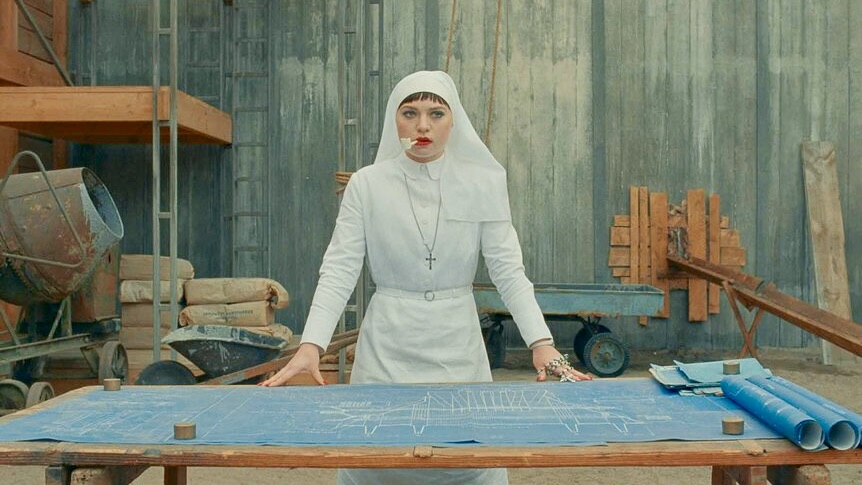
Benicio Del Toro‘s magically performed, perpetually shambolic, ruthless billionaire industrialist and arms dealer, Anatole “Zsa-zsa” Korda, dubbed “Mr. Five-percent”, seems to be able to survive the most severe assaults on his life, and multiple assassination plots, but, after yet another near-death experience, and a short trip to the pearly gates (in a vivid Pythonesque tableau), he becomes increasingly aware that he might be running out of lives. So, keen to outmanoeuvre his enemies, particularly his nemesis half-brother Nubar (a deliciously villainous Benedict Cumberbatch), and firmly secure a lasting legacy, he decides to appoint his eldest and only daughter as his sole heir, despite having nine young sons that he has since sired or adopted. The twist is that Zsa-zsa’s equally formidable daughter Liesl (a brilliantly sharp Mia Threapleton) appears to be a dedicated novice nun, about to take her vows, and greatly resents her estranged father, as she suspects him of murdering her mother.
Korda denies his involvement in the bloody deed, Liesl choses to believe him and signs the papers (keeps her outfit, but slaps on vivid make-up), and, joined by an eager, perceptive family tutor, a Norwegian entomologist called Bjørn, who just happened to be present during their feverish exchange (a zany, clever, and entirely game Michael Cera), the three set out to realise Zsa-zsa’s insanely ambitious master plan (compiled in a group of shoe-boxes): the Korda Land and Sea Phoenician Infrastructure Scheme. Essentially, a city oasis in the middle of the dessert.
And, crucially for Liesl, find out who murdered her mother, Korda’s first, and most adventurous wife.
In a roller-coster ride of international espionage, financial machinations, boisterous one-upmanship, academic spy-craft, casual terrorism, high-altitude flirting, and deadly sibling rivalry, Zsa-zsa, Liesl and Bjorn (now as Korda’s administrative assistant), criss-cross an imagined 1950s Modern Greater Independent Phoenicia in the Levant, meeting with Korda’s colourful investors and a myriad interested parties (perfectly all-star cast, that includes Tom Hanks, Scarlett Johansson and Bryan Cranston), aiming to fill the gap in financing, made huge by targeted US government sabotage, and end hereto prevalent slave labour and famine practices in the Korda company (a promise to Liesl).
“I don’t need my human rights” says a dead-pan Korda to his exasperated daughter when she cannot grasp why he is without a passport (or indeed, permanent abode). When one has billions, tax is the only true enemy. The Phoenician Scheme is peppered with such insights, and is worth its watch-time just for the story within the story, the deep affection developing between the travelling trio, amidst the fun, intricately crafted, stylised world of Wes Anderson’s idiosyncratic storytelling.
Developed alongside Roman Coppola, the fable of a man seeking redemption and true connection offers its audience a cornucopia of soulful nuggets hidden behind layers of quirky formalities, much like Anderson’s masterful The Grand Budapest Hotel (2014), but it does not reach the latter’s heights of pure narrative joy. Nevertheless, we end up with a solid case of heart over matter, for what are all the riches in the world worth if you don’t have family to play cards with, after a hard-day’s work?
The film is dedicated to Anderson’s late Lebanese father-in-law, an industrious, larger-than-life patriarch, who took him under his wing, and with whom he bonded over work and an authentic life worth living — and it shows.
★★★★☆
Author: ©Milana Vujkov
 Lola On Film