Writer/director David Lowery‘s operatic, visually breathtaking and highly stylised psychological drama Mother Mary (2026) turned out to be so much less than what it could have been, firstly for the reason that its two female leads chose to inhabit two entirely different cinematic universes, and secondly because the film’s occult-fashion settings overpowered the dynamics of its key relationship.
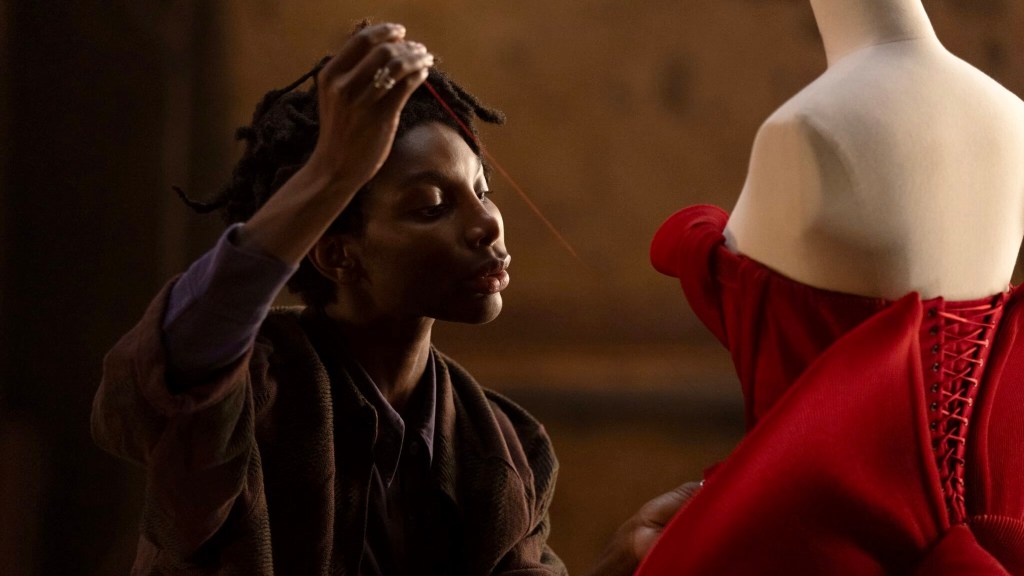
Theatrical and hyperbolic, Michaela Coel‘s Sam Anselm is a successful designer, who lives/works in a Gothic mansion, surrounded by a group of wonderfully eager, impeccably groomed minions, and still she is also a bitter and twisted ex-girlfriend and ex-employee of a pop idol, dubbed Mother Mary, inhabited by an invested, earnest, Anne Hathaway. Sam is haunted by the rejection she had once endured, to the point of insane rage, while Mother Mary, a singer with great beauty yet zero charisma, and millions of fans hanging on her every vacant verse, laden with guilt, and in a creative funk, runs back to her ex, so she could be given one more perfect costume. Which would presumably solve her ongoing identity crisis.
All about the volatile, egocentric Mother Mary’s image had been almost in its entirety manufactured by the feverish, possessive Sam, as a fruit of their love and creative collaboration, yet it was publicly unacknowledged by the pop idol, and this very human betrayal plays out in a macabre way, as a ghost story (a Lowry theme), which sits in the soft bleeding centre of this otherwise coldly executed horror of a spurned lover’s esoteric revenge, ending with a weirdly professional sort of character redemption.
Which brings us to Lowery’s ongoing need for controlled, reserved aestheticism in his filmmaking, something that can work well in the hands of a Tom Ford, as director, who perfected the category, knowing through experience that a beautiful bespoke suit requires a complicated, messy body to wear it, so it can come to life. An icon of the world of fashion, Ford understands its limitations, and elegantly avoids them in his cinema. Lowery, on the other had, is a cinema man, who (it seems) does not understand the dangers of extreme aestheticisation in drama. So in Mother Mary he oppress a narrative already saturated by themes of aesthetics by even more aesthetics, without much diegetic reason except visual delight.
There is something inherently confusing about Mother Mary‘s lack of focus on its humans, and at the same time, a deep need for a full psychological and spiritual interrogation of one toxic relationship.
Despite all this, there is a certain craftiness to the film, purely in terms of depicting ritual. As if the entire piece is a kind of spell-work that accidentally found itself enacted on screen. An examining of the connection between possessiveness and possession in a wizardly way. If the other elements of the story had been more developed and, excuse the pun, more expertly tailored, Mother Mary could have veered towards a Jodorowsky exploration of cinema as magical tool, and in an interesting way.
It is a special kind of disappointment to have so many aspects of a film be, in themselves, incredibly fascinating, but weaved together as a story, quite plain.
★★☆☆☆
Author: ©Milana Vujkov

