Lola On Film reviews fine indie shorts in its Lola Loves Shorts series.
In this lovely, pensive autobiographical documentary collage on sisterhood, love and fate, director Maria Munro, with her soothing, purposefully childlike narration, supported by an elegant solution of illustration (Julia Hostetler, also editor) and telephone conversations bridging gaps in source material, dives deep into her family lore, prompted by a lucid hunch amidst a global pandemic, and sets to find her long lost secret sister — only to meet her briefly and then lose her again.
Born and raised in Venezuela, and living in Canada, one of four siblings in a close-knit Maracay family, who slowly drifted apart in adulthood, Maria travels to her native country, after some time away from its shores, to investigate the background of the story surrounding the fate of her father’s first child, begotten in a youthful post-college affair with a household employee in his parental home in Caracas, never to be spoken about publicly, particularly in her father’s subsequent marriage to Maria’s mother.
Preparing herself to meet Cecilia, the secret daughter (discretely supported by their paternal grandparents, and sent to school in Trinidad), now living in Caracas, who joyfully reaches out after hearing via “the cousin network” of Maria’s interest in connecting, the director steps into a labyrinth of family history, a conundrum of assumptions and concealed circumstance, which she begins to very carefully unweave. Through what the director chooses to reveal to us in archival photographic detail, we also glimpse what is to remain hidden, only known to the protagonists themselves. Sometimes this is a conscious decision, but more often it seems a reflexive, societal one, circumventing any disturbance to a status quo of family dynamics and social mores.
Sisters/Hermanas couples an entirely charming animation (Dylan Moore) and score (Ross Munro) with images of old-time Venezuela, blended seamlessly with fresh footage of the busy modern streets of Caracas, Maria’s frail but bouncy mother, family memories on apartment walls, Hotel Maracay, a ghost of its former splendour, all whispering of a shared story and a filtered past, often a mere nostalgic construct that might have played out differently had the elements of what lie beyond been exposed.
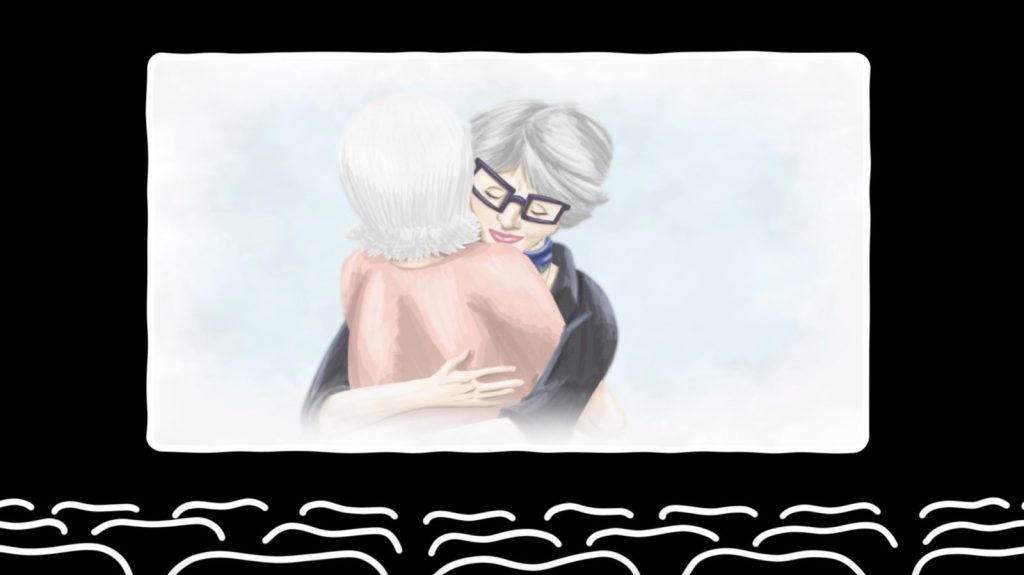
When Maria finally meets Cecilia, it is by their own independent design, regardless of the constraints of the past, driven purely by the wish for authentic sisterhood, a sense of true belonging, genuine care, and elation in each other’s company. They meet in a Spanish restaurant, resembling a scene “in a Hollywood movie” the director exclaims, giddy and full of stories to tell, like they had know each other forever.
What is most moving about this short-form gem, other than the knowledge of the ephemeral nature of happiness it conveys, as Cecilia dies only six moths after their first and only meeting, is the way it gently exposes the wrongs of a family unit, but with utmost care and mature sense of understanding.
Maria, back in Vancouver, looks and sounds different, somehow whole, as if the not knowing about something so precious had left her missing a significant part of her own life’s puzzle, one that was now set right — for Cecilia’s sake, and her own.
The integration of Cecilia into the family through Maria is a healing journey of its own, and a profound one, the element of the story I most cherished as an outsider, a simple spectator to an unfolding of a highly intimate story, yet also a gentle meditation on sisterhood, the sacredness of truth, the importance of acceptance, a reunion that transcends death.
Author: © Milana Vujkov


2 responses to “Lola Loves Shorts: Sisters/Hermanas”
Thank you so much for your thoughtful review. I’m deeply grateful for the care and attention you brought to “the film”Sisters”, it truly means a lot to me.
Really loved it. Beautiful film.