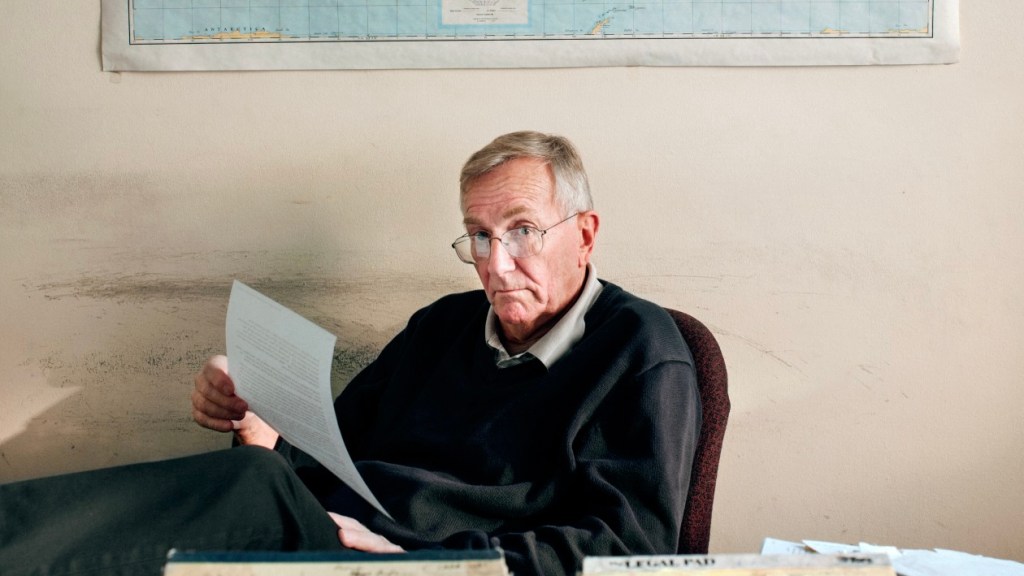
The cinematic craftsmanship, political insight and archival integrity on display in Cover-Up (2025) is astonishing in its precision, depth and scope, and yet to be expected, as it centres around the life and work of Seymour Hersh, the Pulitzer Prize-winning investigative journalist whose first major report had been uncovering the My Lai massacre (1968), during the Vietnam War, while the documentary is directed by Academy-award winning Laura Poitras, helmer of Citizenfour (2014), and Emmy-winning Mark Obenhaus, a seasoned ex-ABC producer, who worked with Hersh in the Dangerous World: The Kennedy Years (1997).
It took Poitras two decades to convince the sceptical, private and temperamental Hersh to commit to the endeavour of narrating his process of cutting-edge journalism and relentless pursuit of truth, his methods of protecting his anonymous sources and following incendiary leads, and his rightful claim of speaking truth to power, in the most high-stakes circumstances (he still threatened to walk-out on the proceedings, at least once).
To be the person to expose My Lai war crimes, Operation CHAOS spying programme, and Abu Ghraib prisoner torture, and face the formidable governmental backlash, from the likes of Pentagon, US State Department, and the CIA, one has to be made of specific moral material, so rarely found any more in contemporary corporate media circles. Hersh also worked for both The New York Times and The New Yorker, yet his determined solo reporting style still overrode the necessary adjustments journalists had to make in order to be able to utilise the platforms these publishing giants offered. Sometimes to his own career detriment.
Poitras and Obenhouse were meticulous in compiling the archival material that makes for most of the 2h running time of Cover-Up, interlaced with the straight-forward, often curt, sometimes jesting Hersh, now in his mid-80s, talking to the filmmakers or just going about his business. While what we witness in his vocational trajectory is the actual shadow history of the United States, from the 1960s onwards, as that is where our protagonist focus landed, digging deep into what extreme power, financial and political, sought to bury. The horror of My Lai, deconstructed in detail, brings into frame all the subsequent war crimes (and environmental disasters) brazenly committed in the name of democracy and freedom, underlining Hersh’s mantra that a country based on these principles should not be allowed to get away with never-ending cycles of mass murder.
In view of the current political climate globally, the sentiment is more than prescient.
Reminiscing about his own background, Hersh is more reluctant, but his reporting style of directness and accuracy prevents his private nature diluting the story told (never getting in the way of a story being his core principle), as the few words he does say on both his father and mother, and their family situation, speak volumes, illuminating the entire landscape of Seymour’s childhood and youth. The son of immigrants of Jewish Lithuanian and Polish descent, settling in Chicago, Illinois, in the 1930s, Seymour was excellent at school, but locked-in to run his family’s dry-cleaning business, as his father judged him to be people-savvy, unlike his twin brother, who was thus allowed to pursue college. Still, it was Hersh’s intellectual curiosity and sheer writing talent that burst the dams open, and in one of his rare emotional moments on camera, he relives the joy of being selected for the University of Illinois Chicago, as a pivotal life-changing event.
His subsequent rise in the ranks of the fourth estate was through grit and determination, backed by a solid family unit, and a strong marital partner, as well as an uncanny sense of social urgency in bringing an important story to light. But, the true driver behind the laconic exterior is a vast sea of empathy with the downtrodden of the world, a humanitarian soul finding its exact purpose, emphasising the social justice aspect of Hersh’s work, which makes all the difference in the way his legendary reporting has thus far unfolded (he is still going strong).
In a way, both Hersh and Poitras represent the best of America, being perfect avatars of its promise of liberty, and becoming the harshest critics of all the ways this experiment failed.
The existence of this documentary is, therefore, also an astonishing testimony of the downward spiral of a country which regardless of its controversial beginnings became a beacon and a harbour to many that reached its shores, shedding their past and re-inventing a bright future (not unlike the US, itself), while its entirely novel type of societal milieu and ways of governance gave birth to a modern way of expression mirrored (and sought after) by the entire world. Nevertheless, through its (re)invention of cultural soft power, and equally, its deeply corrosive and aggressive type of neocolonialism, hell-bent on concealing ones own grave faults and misdeeds, it is also a study in narcissistic fury unleashed whenever its underlying historical hypocrisy is revealed and imperial interests thwarted.
Which, I suspect, represents a key purpose of this fascinating, unyielding and courageous doc.
★★★★★
Author: ©Milana Vujkov

