“Blue moon, you saw me standing alone
Without a dream in my heart
Without a love of my own.”
Director Richard Linklater‘s subversively mellow biopic Blue Moon (2025) might be theatrical, snail-paced, and incredibly insular, yet Ethan Hawke in its central role (and every frame), as famed songwriter Lorenz Hart (author of numerous tunes, musicals, as well as the whimsical, iconic Blue Moon, whom he claims to dislike), is so heart-wrenching, fiercely present, powerfully vulnerable, that the picture leaves one an emotional shipwreck after viewing it, and that is a good thing.
Penned by Robert Kaplow, based on the correspondence that the middle-aged Hart had with Elizabeth Weiland, his lively, daring and ambitious twenty-year-old art school protégée (soulfully conjured by Margaret Qualley), it is a masterclass in conveying a landscape of deep psychological damage through a small bitter-sweet witty line or the fleeting deadened gaze of the perpetually romantically rejected (often due to a chronically inappropriate choice of potential relationship).
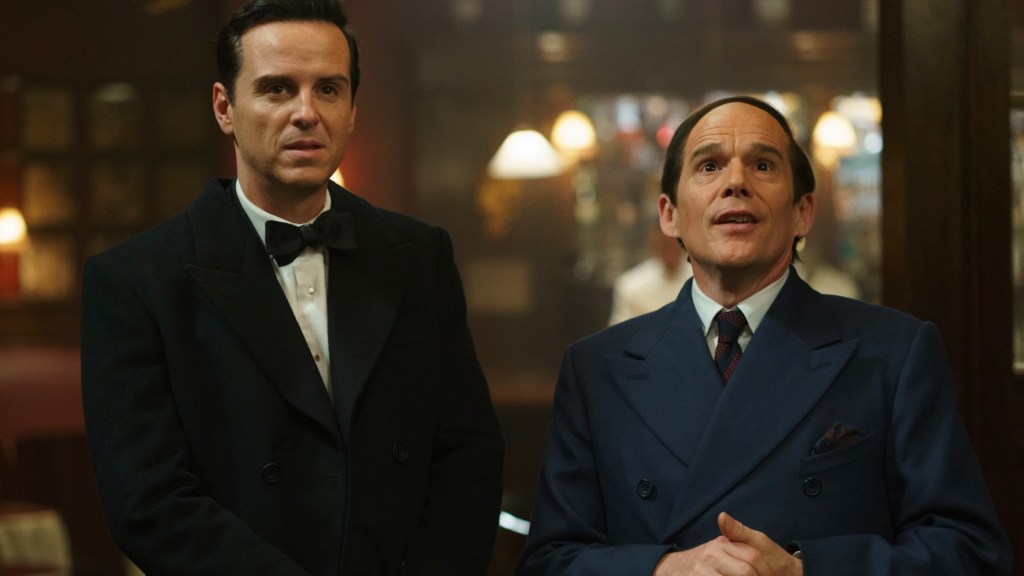
Filmed in one full sweep, and one ochre room, NYC’s Sardi’s restaurant, Hart’s regular drinking spot, with its sympathetic barman (a smooth Bobby Cannavale) endeavouring to regulate the writer’s notorious and ultimately lethal alcohol intake (sadly, in vain), into which he fumed in after the premiere of the 1943 Broadway mega-hit Oklahoma!, which Hart’s long-time creative partner, composer Richard Rodgers (a dry, pitch-perfect Andrew Scott), co-authored with someone other than him (i.e. Oscar Hammerstein, a boisterous Simon Delaney), particularly as a result of the flakiness Hart exhibited in their partnership, aggravated by his advanced alcoholism.
Blue Moon traces the origins of artistry in personal pain in such a delicate, level-headed way, that it is almost too respectful, but then it suddenly surprises the viewer by firmly not shying away from the murkier, kinkier, addictive, oh-so-human aspects of Hart, directly addressing the devastating suffocation of his closeted lifestyle. Hart, who was (possibly) homosexual in an era that incarcerated gay men, and worked in an industry that “tolerated” the non-heteronormative if it did not outwardly present as such (too much), so evidently considered himself to be unappealing, and unlovable, that this not-so-secret agony touched every aspect of his existence, colouring with melancholy even his most life-affirming lyrics.
Hart describes himself to Elizabeth, whom he relentlessly and very publicly courts, as “drunk on beauty”, male or female, still or in motion, when she hints at knowing of his true preferences (as gossip conveyed by her theatre insider mother). And, in the way the lyricist thirsts to hear every single detail of the ingenue’s budding love life, he seems more pansexually voyeuristic in this unsettling platonic age-gap infatuation, than would be expected of a performatively amorous, overly curious confidant.
Theirs is a companionship of kindred spirits, for sure, but with one spirit being the proverbial gardener, the other, the flower, which is, more or less, what Hart concludes to yet another denizen of Sardi’s, the quietly perceptive E. B. White, writer, essayist, and a contributing editor for The New Yorker (a wry Patrick Kennedy), who, in this film, squarely jots down Hart’s off-the-cuff city mouse idea as premise for his celebrated 1945 children’s book Stuart Little, and whose poetic prose Hart openly admires.
Not so with the crowd-pleasing Oklahoma!, which Hart despises and envies in equal measure. Hawke’s sparring with Scott, Hart and Rodgers exchanging sharp jibes and casual endearments, as two people that know each other really well would — and Hawke’s breathtaking scene in a literal coat-check closet with Qualley, as Elizabeth, confiding to Lorenz her own lust, sexual embarrassment and heartbreak at rejection, honestly and with much self-depreciating wit — embue Blue Moon with a thespian bravura that makes the static chamber setting sparkle with dramatic intensity.
Hart is verbose, prolific in his creativity, bubbling with insight, joviality and rhyme, at the same time fully aware of his faults and the injustices of life, and for this dichotomy he seems to seek relief in intoxication, drinking himself to death on the streets of New York after the opening of his final collaboration with Rogers, the revival of A Connecticut Yankee, in November 1943, shortly after his widowed mother’s passing (whom he lived with), and the time this story is set in, at the age of 48.
The beautiful Oscar-nominated performance by Hawke is the heart of Blue Moon, but its beating pulse belongs to Qualley, as the forthright, ultimately devastating Elizabeth, who brings out the life in Hart (word-play intended), and then takes his breath away through unrequited affection, waltzing off into the night with his more handsome, significantly slicker partner Rogers, bearing a sweet pragmatic smile.
The original title of the Blue Moon tune was The Bad in Every Man, with different lyrics, the title song for the 1934 Manhattan Melodrama (and not even its first incarnation, which was written for Jean Harlow, and an earlier picture).
A haunted, imperfect melody, layered and enigmatic, much like its writer — and this film.
★★★★☆
Author: ©Milana Vujkov

