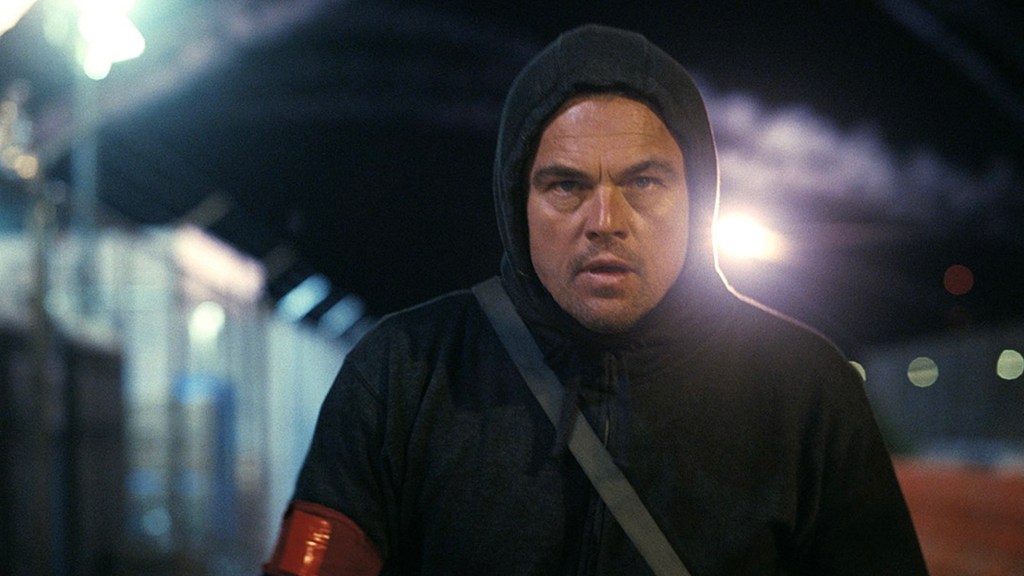
A film that has garnered the highest accolades, as multiple Oscar-winning Paul Thomas Anderson‘s One Battle After Another (2025) has done, seems a daunting prospect to take on with a mild three-star review, but after watching it twice, I am left with the same feeling of technical and artistic excellence lacking coherence. A beautifully crafted picture without a conceptual frame, with a labyrinthine narrative potential of the director’s groundbreaking Magnolia (1999), ending up lost in its own maze. There is an intellectual malaise within its two-and-a-half-hour-plus suspense that is pretty hard to describe, without it becoming too personally political (as I am a person of the left), so I will endeavour to keep things ideologically as neutral as possible, and work from that point outwards.
Firstly, let’s gauge the twisted perspective of its long 40-minutes intro, in which the stage is set in an almost mockumentary fashion for the (mostly) earnestly darkly-humorous epic, tracing the exploits of a militant far-left revolutionary group calling itself the French 75, a social and racial mix of die-hard radicals and thrill-seeking hangers-on, who blaze through the densely oppressive atmosphere of the Bush-era noughties (presumably) — maybe even the Obama end of that decade — overwhelmingly targeting immigration facilities, and causing elaborately staged mayhem in the process of freeing the suffering detainees. They also rob banks to fund their revolutionary activities, which turns out to be their (predictable) downfall. An amalgam of Blaxploitation and Tarantino-coded seventies cop noir, the entire prelude seems to be somehow out of whack, a caricature rather than a (perhaps) intended whimsical look at the peccadillos and graver sins of people that choose to live their lives as outlaws, due to moral issues with the powers that be, rather than the usual criminal ones.
In this group we meet Ghetto Pat, the Rocket Man, played by Leonardo DiCaprio with finesse and heart, madly in love with the passionate and increasingly unhinged Perfidia Beverly Hills (a super-charged Teyana Taylor), who seems to be more of a freewheeling sociopath than a genuine freedom-fighter, getting kicks from putting herself at risk, endangering her comrades at every turn. In one of her memorable gunpoint encounters she meets the perverted gaze of Colonel Steven J. Lockjaw (a powerhouse performance by Sean Penn), a covertly racist detention centre commanding officer and avid fetishist of black women, and is blackmailed into a sexual encounter. Sixteen years later on, we are inevitably facing the question of the paternity of Pat and Perfidia’s daughter, Charlene (an impressive Chase Infiniti), long after Perfidia murdered a security guard, snitched on the French 75, went into the witness protection programme — and then fled the country, never to be seen throughout the film again.
After this, frankly, cringy start, the story leaps in time, and steadies. Ghetto Pat Calhoun and his daughter are living a small-town life in the sanctuary city of Baktan Cross, California, an idyllic existence even, considering they both live under false identities, as Bob and Willa Ferguson. Ghetto Pat is stoned into oblivion, but still keeping the edginess of that off-the-grid paranoia. Which turns out to be an accurate assessment, as this was merely a calm before the storm, which hits the moment the ambitious and fanatically committed Colonel Lockjaw wishes to join a coveted white-supremacist secret society, gathering the extremely wealthy, devious and well-connected WASP elite, quaintly called the Christmas Adventurers Club (a Norman Rockwell meets American Psycho situation) and the idea of having a mixed-race daughter as evidence of an inter-racial relationship becomes a problem.
Hence, we enter “the chase” phase of OBAA, which takes up all of the second half of the story, and is, in truth, a genius piece of filmmaking that should have been served a much better narrative set-up. It features the MVP of the entire proceedings, Sergio St. Carlos, an incredibly game Benicio Del Toro, playing Willa’s karate sensei, who also runs a coordinated network of sheltering illegal workers and their families, that move for evacuation through hidden passages like a disciplined army under siege. Lockjaw and his armed troops descend upon the city in a cover drug enforcement operation, while in search of one particular father and daughter. The multitasking sensei smoothly aids an out-of-form bathrobe-clad Ghetto Pat in outrunning the law, through a series of nearly-missed disasters. Pat heads to the convent that is run by Sisters of the Brave Beaver, radical nuns that grow marihuana (apparently, a RL institution), who offer shelter to Perfidia’s offspring, brought to them by Deandra (a tuned-in Regina Hall), the only well-drawn revolutionary in the entire picture, and who promptly inform the fiery daughter of her mother’s treachery (Willa was told by her dad that Perfidia died a hero). Pat tracks Willa through underground info channels that had subsequently “gone woke” in the funniest of ways. A showdown ensues.
OBAA is loosely based on a Thomas Pynchon 1990 novel Vineland, the second Pynchon text Anderson adapted (the first, in 2014, being Inherent Vice), which, in his words, took him almost two decades to write, and there is an idiosyncratic Americana electrical charge to it that is undeniable. The backdrop of a city on fire, parkour skaters acting as messengers, meaty agent provocateurs inciting riots, police armed to the teeth raiding teenage school dances, Indigenous American assassins with morals, fascist survivalist militias with none, raggedy air-headed radicals fighting the good fight, community-led underground resistance on the air-waves, endless labyrinthine car chases through the perennially photogenic California desert landscape (all masterclass tracking shots) — the absurdist race-obsessed violence of the lofty construct that is the USA depicted seamlessly, breathlessly, in virtuoso style, keeping the viewer glued to their seats.
Yet, despite the formidable cinematic value of its second act and its emotionally eloquent central family saga, OBAA ends up fundamentally hollow, a tautological film about politics that evidently abhors politics. Its cynical attitude towards revolutionary vigour veering towards realpolitik in uncomfortable ways for what is primarily meant to be a pro-immigration epic, set in the midst of Trump’s America, with its heart on the right side of the moral universe.
There is a slickness to this combustable dynamo of a film that obscures the solutions to a problem, while fully exposing the problem — allowing only for a never-ending series of pragmatic short-term hacks and long-term circular fails, with all the radical steps being spectacular misfires, leaving us with the cold-hearted assumption that the problem faced is essentially unsolvable.
America’s slaver beginnings, the ongoing consequences of a house built on stolen indigenous land, a nation of immigrants founded on principals of equality becoming a nativist society, seem to be portrayed as a series of fated events that defy any impactful transformational agency, except the occasional excellence in defiant adaptation to the state of affairs, as witnessed with Del Toro’s masterful sensei. Which, other than the father-daughter bond, is clearly the only thing Paul Thomas Anderson firmly believes in.
OBAA is thus straight-forwardly liberal-conservative. Which would be a fair-enough PoV, if the film did not also fiercely position itself as staunchly progressive. And in this little self-delusion lies the entire inauthentic rub.
★★★☆☆
Author: ©Milana Vujkov

