Writer-director Zach Cregger‘s ingenious and enigmatic horror Weapons (2025) took me by surprise, as I never expected a genre film of its ilk to be a philosophical piece par excellence, leaving me dwelling within its shadow, thinking of clues to crack its mysterious code for a long time after viewing. In the end, I got it, but not before I read several of the director’s interviews, and sat with my own gut reactions to its episodic POV narrative, apparently written in a state of therapeutic automatic writing, following its doomed storyline, full of dark humour and existential dread, to its inevitably gruesome and entirely cathartic crescendo.
So, yes, there will be a few spoilers ahead, as there is no other way to write about this warped masterpiece other than diving straight into its whirlpool. My advice would be to watch it before reading the rest of this review, and have your own journey of discovery untampered with.
Let’s start with the premise.
The invisible narrator, a young girl, informs us that one night, in a small-town in America, all the children in a class, except one, got out of their beds at 2.17 am, walked out of their homes in their pyjamas, ran down the street (their arms strangely flapping), and disappeared. The next morning, when their teacher entered the class, there was only one lonely boy seated in it. The police were called in, questioning the teacher, Justine Gandy (Julia Garner), and the boy, Alex (Cary Christopher), but neither seemingly had any clue about what occurred.
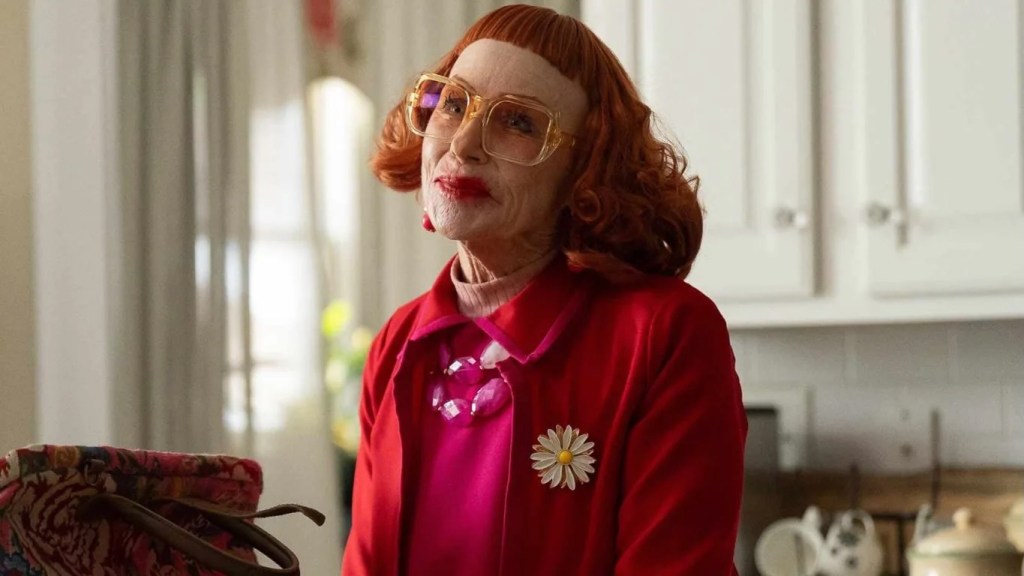
The entire town then promptly slipped into a daze of confusion, mutual accusation, devastation, denial, and stupor, while at the centre of this miasma a dark force slowly started to show its macabre face in the shape of an elderly lady, with clownishly applied make-up, flaming red-haired wig, and a penchant for garish 1970s style of dress. Soon we find out that this is Alex’s Aunt Gladys (Amy Madigan), visiting from out of town, taking care of the boy, while his parents are ill with “consumption”.
The focal point of the town’s displeasure, Ms Gandy, haunted by the event and accosted by angry parents, aims to get to the bottom of this vanishing, driven by a final-girl determination, certain that her shy and reclusive student Alex must hold the key. She is inevitably barred from approaching the boy.
The story disperses into several tellings of the narrative, Rashomon-style, back and forth in time, like a single record playing on a loop, enhancing different sections, re-visiting the violence that erupted amongst the townsfolk, and the strange trance-like, weaponised state of all the perpetrators of it. Through the lenses of key characters, Justine, and her ex-lover, a married policeman, Paul (Alden Ehrenreich), James, a junkie that Paul attempts to arrest (Austin Abrams), an angry father of one of the parents, called Archer (Josh Brolin), with whom Ms Gandy finally forms an allegiance, as well as, finally, the mysterious, traumatised Alex, the audience enters the narrative void, in search of its occult core, that one key component to a sudden collective misery.
The acting is uniformly excellent, with Amy Madigan leading in absolute dedication and fierce presence (winning an Academy award for the performance), and Austin Abrams, as the ill-fated crack-addict, offering a terrifyingly accurate characterisation, within the frame of the blackest of satires.
The tight genre constraints work perfectly in synch with the in-depth psychological analysis of societal malaise in the Trump era of rage, exposing the masks people wear in presenting normalcy, the addictions they secretly (or not so secretly) harbour, the effect their thus possessed state has on them and their environment, the acts of cruelty they casually commit, a ramped-up, yet misguided sense of righteousness, and how easily scapegoats are sacrificed for all the ills a community creates.
Yet, there is even more to this story. Something ancient, and not modern at all.
Weapons is set-up as a 21st century Gothic fairy-tale, conflating decades, yet it ends up transcending millennia. Aunt Gladys might be the diseased wicked witch of lore that enters a place, captures its people through spellwork, bending them to her will, feeding off their life force in order to continue to exist, but she is more than meets the horror-fan’s eye, far beyond the tropes she represents. Those precise and ominous shots of neon-infested liquor stores, contaminated needles lurking in pockets, a magical plant worshiped for its potency, sweeping visions of AK rifles in the sky, present us with a villain that is not so much a human, rather more an amorphous entity, a putrid substance, requiring human flesh to be conjured into life, affecting the human spirit, abducting all its agency, zombifying or enflaming emotions, instigating decay, bloodshed, oblivion, directing its prey as a cruise missile, on a trajectory of destruction, of self and of others.
The final act of vengeance upon this creature by the children whose lives it so callously abducts is at the same time horrendous and darkly hilarious.
For my money, Weapons is perhaps the most finely executed and devastatingly accurate portrayal of substance abuse and addiction I have ever seen, without even attempting to present itself as such. Thus amplifying its punch when the realisation of its intricately codified message lands.
★★★★★
Author: ©Milana Vujkov

