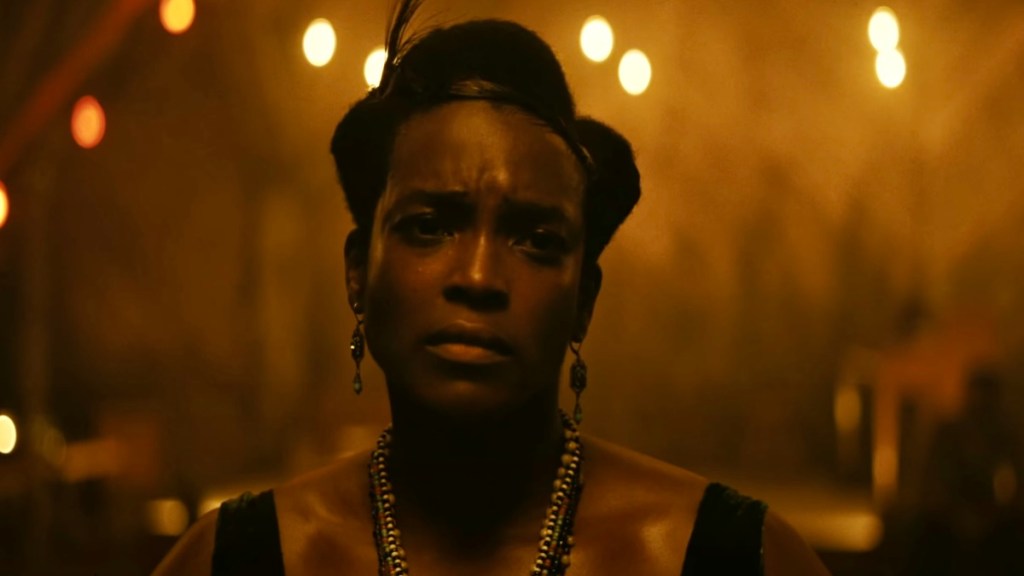
“You keep dancing with the devil, one day, he’s going to follow you home.”
Kinetic, thrilling, and visually ravishing, writer/director Ryan Coogler‘s high-octane deep-South epic Sinners (2025) is a quintessential (horror) tale of art, damnation, and the long road to redemption, twisting and turning in a time-magic fashion around one night of October the 16th, 1932, when the veil between worlds had thinned, and cross-overs happened, impacting the segregated world of Jim Crow the film depicts, thoroughly and irrevocably.
The layered storyline of Sinners is as rich and juicy as is the blues rhythm it depicts (Oscar-winning score, Ludwig Göransson), and to fully grasp all its nuances one really needs to re-view it at least once (Coogler won an Academy Award for Best Original Screenplay). As a full nourishing meal of cinematic goodness it works its way in one sitting too — albeit imperceptibly, as rare spices often do, and as great music does, especially when it is heavenly.
Young Sammie’s (Miles Caton) heavenly music is what summons the devil on that faithful night, just as his pastor father Jedidiah warned that it would (Saul Williams), yet it also draws in all the black folk, straight off the cotton-fields and rickety porches, dusty small-town streets and segregated convenience stores, and into the conjured juke joint, Club Juke, established in one single day by Sammie’s cousins, slick gangster twins Smoke and Stack (Oscar-winning Michael B. Jordan, both) fresh from Chicago, with stolen mobster booze and loot, and a point to prove, as this was once their home turf, and their youthful past is as present as if it happened yesterday, with all its hidden pains and desires. They buy the sawmill they plan to transform into their life-long venue dream from a dodgy white local named Hogwood (Dave Maldonado) — as it transpires, and inevitably, the Grand Dragon of the Ku Klux Klan — and proceed to recruit their friends and family in assisting in what would be a paradigm-shifting community endeavour.
As the chef they entice Smoke’s formidable ex-wife Annie (Oscar-nominated Wunmi Mosaku), owner of a friendly Hoodoo herbal shop, a lively Chinese shop-owner couple, Grace and Bo Chow (Li Jun Li and Yao), to supply the goods, and a wise old boozehound Delta Slim (Oscar-nominated Delroy Lindo), to man the piano, and hold their young gifted nephew Sammie steady at the guitar and vocals. Hefty Cornbread (Omar Benson Miller), straight from the fields, mans the doors. Stack’s ex-girlfriend, the seductive, (ominously) white-passing Mary (Hailee Steinfeld) appears too, seemingly out-of place, but determined to be where she feels at home most, which is, as we soon find out, back with Stack. And then, there is a party to end all parties, weaving the past, present, and future together, a celebration of culture, fortitude and heritage, a scene that is both hallucinatory and incredibly oracular, a transcendent stunner (curtesy of Oscar-winner Autumn Durald Arkapaw‘s cinematography).
Sinners is neatly sliced into two parts, of a very different nature, the first being the pitch-perfect frenzied lead-up, the second, the conjured other-worldly main dish, mixed with a few dissonant tones, which, in a film about the irresistible pull of artistic genius, the magical effect of a craft perfectly done, makes for a few dents in its otherwise finely tuned body. The second part is also where the horror truly starts. The temple is built, sacred space established, ancestors invoked by the ceremony, and that, predictably, invites the attention of the wrong crowd. In this case, alongside the conniving Klansmen, a centuries-old Irish-immigrant vampire, Remmick (Jack O’Connell), who, fleeing Choctaw vampire hunters, and befriending (i.e. slaying) a Klan couple, lustful for a past he had been cut off from and the tunes of his own ancestral lands, tricks and bites his way to the door of Club Juke, and politely asks to be let in.
Underneath the repressive cruelty of the segregated South of the United States of America flourishes a culture of a people that did not forget their roots and spiritual language, the music that has been alchemised through lives of both suffering and beauty has a celestial quality that opens up portals, and draws in everyone who appreciates this connection to its source. Art, in itself, although it inclines towards the divine, must also be a true representation of the human condition, which allows the corruption of intentions to creep in. Sinners is an allegory of this condition, told in a genre that is not known for its nuance. Horror rarely leaves space for the subtle detail. And that is the only fault of the film.
However, Coogler utilised it for a reason. The frame is as important as the image. The existential terror that was slavery runs through this tale like a blade, always present, never fully vanquished. Immigration is another level, a state of liminal existence, a place “between worlds”, an adaptation that demands some sacrifice of the soul. The vampire analogy of the truly bone-chilling character of Remmick, and the beautiful way his longing for his homeland is rendered in Irish folksong, speaks of a state of grace within this imposed societal isolation where a will to find a path to the hearth of heart exists, alleviating the spiritual infection the pull of nostalgia draws in. Even within the depths of his own hell, Remmick craves to build community, a house for the damned, and pull new acolytes amongst the townsfolk in.
The only ones with a full understanding, command, and (non-violent) claim to the place all our characters inhabit are in the story for a very short time. The Choctaw hunters know the nature of Remmick on sight (as does Annie, through her Hoodoo practice). They even warn the Klan couple who choose to shelter him (persuaded by Remmick’s falsely professed racist views), and who clearly do not have a clue. They built their home on a living and breathing territory they do not comprehend, thus are doomed to possess it obliviously, defending it as theirs until the end of time. Such is the fate of the coloniser.
It is the societal structure, the false hierarchy on a shared land, that is preventing it not fully belonging to anyone residing on it, that is the true evil Sinners exposes, not the proverbial “melting pot” itself.
Sinners ends in a conclusion of sorts, after a passing of time, in a loop, on the same date it had started, but in Sammie’s lifetime span, and with something to say about the destiny of the artist. What the price of anything made heavenly really is.
An outstanding achievement, albeit slightly chipped during delivery.
★★★★☆
Author: ©Milana Vujkov


One response to “Sinners”
It is an incredibly seductive and lush environment that draws you into the somewhat inevitable outcome. The bottom drops out somewhat abruptly and the loose ends of the plot are tied up a bit too concisely. Re-viewing the film will smooth out the pacing and reinforce an appreciation for the layered themes.